New Americans, New Champions: The Immigrant Athletes Who Quietly Rewrote the Olympic Record Books

Photo: NASA Goddard Space Flight Center from Greenbelt, MD, USA, Public domain, via Wikimedia Commons
The story Americans love to tell about Olympic success is a clean one: homegrown talent, small-town training facilities, raw determination, and a flag raised at the finish line. It's a good story. It's also incomplete.
Because for as long as the United States has competed at the Olympics, athletes who were born somewhere else — or whose parents were — have been a significant part of why America wins. Their contributions have been real, consistent, and sometimes quietly controversial. And together, they've rewritten what it actually means to be an American Olympic champion.
The Early Years: When "American" Meant Something Narrower
At the 1896 Olympics in Athens — the first modern Games — the United States sent a small delegation of athletes drawn almost entirely from elite East Coast universities. These were men of Anglo-Saxon Protestant backgrounds, competing in a tradition that borrowed heavily from British amateur athletics. The team was American in the narrowest possible sense: native-born, largely privileged, and representative of a particular slice of the country's population.
That began to change almost immediately. By the early 1900s, the United States was absorbing massive waves of immigration from Southern and Eastern Europe, and the children of those immigrants were growing up in American cities with something to prove. They found their way onto track teams, into boxing gyms, and eventually onto Olympic rosters.
Marathon running provides an early example. The 1908 Olympic marathon in London featured Johnny Hayes, a New York City runner born to Irish immigrant parents, who won gold after the original finisher, Dorando Pietri of Italy, was disqualified for receiving assistance near the finish line. Hayes was American by birth, Irish by heritage, and his victory was celebrated in immigrant neighborhoods across the eastern seaboard as much as anywhere else.
The Depression Era and the Hunger to Win
The 1930s produced some of the most complicated and compelling chapters in American Olympic history. Jesse Owens' four gold medals at the 1936 Berlin Olympics remain among the most celebrated moments in sports history — a Black American from Alabama defeating athletes in a stadium built to showcase Aryan supremacy. Owens' story is well known. Less discussed is the broader composition of the 1936 American team, which included multiple Jewish athletes competing directly in the shadow of Nazi ideology, some of them first-generation Americans whose families had fled persecution in Europe.
Marty Glickman and Sam Stoller, both Jewish sprinters, were controversially pulled from the 4x100 relay at those Games in a decision that has never been fully explained and has long been suspected of involving political pressure from American officials uncomfortable with the optics. Their exclusion is a reminder that immigrant identity in American sport has never been straightforwardly celebrated — it has always been complicated by questions of who gets to represent the nation and on whose terms.
Cold War Competition and the New Talent Pipeline
After World War II, American Olympic success became entangled with Cold War politics in ways that reshaped how the country recruited and developed athletes. The Soviet Union's entry into the Olympics in 1952 created immediate pressure to find the best possible competitors regardless of background, and that pressure gradually opened doors that had previously been harder to walk through.
The Cold War era also brought a new kind of immigrant athlete: defectors. Gymnasts, wrestlers, and track athletes from Eastern Bloc countries occasionally sought asylum in the United States and eventually competed under the American flag. Their arrivals were politically charged and athletically significant, bringing training methodologies developed under state-sponsored Soviet and Eastern European sports programs into American coaching culture.
The Modern Wave: First-Generation Gold
The most dramatic transformation in American Olympic identity has unfolded over the last three decades. The 1990s through the 2020s have produced a generation of American Olympic champions whose family histories span virtually every continent, reflecting immigration patterns that have fundamentally reshaped the country's demographics.
In track and field, sprinters and distance runners with roots in the Caribbean, West Africa, and East Africa have become central figures in Team USA's medal haul. Distance running in particular tells a striking story: American marathon and distance results improved significantly as athletes with East African heritage — born in the US or naturalized citizens — began competing at the elite level, bringing with them training philosophies and physical conditioning approaches that had dominated international distance running for decades.
In gymnastics, Simone Biles — whose story is more complex than simple immigration narratives but whose background reflects the diversity of modern American life — became the most decorated American gymnast in history, winning four gold medals at the 2016 Rio Games and continuing to compete and dominate years later.
Weightlifting, fencing, judo, taekwondo, and shooting have all produced American medalists in recent Olympics whose families arrived from Asia, the Middle East, and Latin America within living memory. Each of them carries a version of the same story: parents or grandparents who came to the United States seeking something better, and children who channeled that inherited drive into athletic excellence on the world's biggest stage.
The Question Underneath the Gold Medal
America's relationship with its immigrant Olympic champions has never been entirely comfortable. There is a persistent strain of sports commentary that treats foreign-born athletes or first-generation competitors as somehow less authentically American than athletes whose families have been here for generations. It surfaces in subtle ways — in how certain athletes are described, in which backstories get the primetime feature package, in which gold medals feel like "our" victory and which feel more complicated.
But the timeline doesn't lie. Wave after wave of newcomers has arrived in this country, and wave after wave has produced athletes who stood on Olympic podiums in American colors. Irish immigrants in the early 1900s. Jewish immigrants in the 1930s. Caribbean athletes in the latter half of the 20th century. East African-heritage distance runners in the 2000s and 2010s.
Each wave brought something the American sports system didn't already have: a different kind of hunger, a different training tradition, a different relationship with competition forged in circumstances that made winning feel like more than a game.
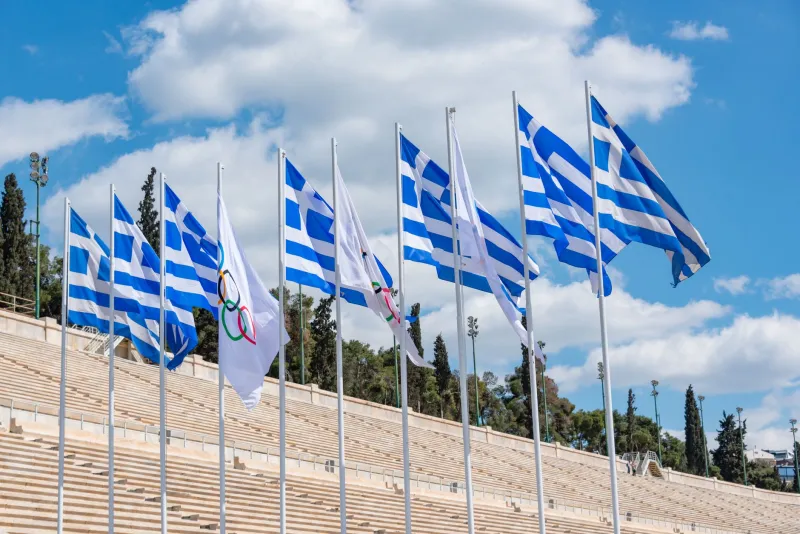
The Games Timeline stretches back to ancient Olympia, where Greek city-states sent their best men to compete for civic glory. America has always been its own kind of city-state — one built from everywhere else. The Olympic record books reflect that, whether the sports pages always say so or not.