From Wilting Leaves to Million-Dollar Medals: The Surprising History of Olympic Hardware
If you handed a modern Olympic gold medalist a freshly cut olive branch and told them that was their prize, there'd probably be a long, uncomfortable pause. Yet for nearly a thousand years, that's exactly what the greatest athletes in the ancient world competed for — a wreath of leaves that would start to wilt before they even got home. And they fought their entire lives to earn it.
The story of how athletic achievement gets physically represented is, in many ways, the story of how sports culture itself has changed. What we give champions says a great deal about what we think winning means.
The Wreath That Was Worth Everything
The ancient Olympic Games at Olympia began in 776 BC as a religious festival honoring Zeus, and the prize for victory was deliberately, pointedly humble: a kotinos, a wreath cut from a wild olive tree near the temple of Zeus. No cash. No silver cup. No endorsement contract waiting at the finish line.
This wasn't an oversight. It was a statement.
Greek culture placed enormous value on honor earned through effort rather than material reward. The olive wreath was a symbol of divine recognition — the gods, through the judges at Olympia, were acknowledging your excellence. That acknowledgment was considered so valuable that no physical object could adequately represent it. Giving a winner gold would have almost cheapened the moment.
And yet those victors were anything but unrewarded in practical terms. Return to your home city with an Olympic wreath and you could expect free meals for life, front-row seats at public events, and the kind of social status that money couldn't buy. Cities sometimes knocked holes in their walls to welcome champions back — the idea being that a city capable of producing such an athlete didn't need conventional defenses. The wreath was the symbol. The lifetime of privilege was the substance.
The Pythian, Isthmian, and the Rise of Laurel
The Olympics weren't the only major Games in ancient Greece. The Pythian Games at Delphi awarded a laurel wreath. The Isthmian Games gave out pine. The Nemean Games used wild celery. Each choice was tied to the specific religious tradition and mythology of that site.
What's fascinating is how these different symbols carried distinct cultural weight. Laurel, associated with Apollo, carried connotations of artistic and intellectual achievement alongside athletic excellence. When Roman generals later adopted the laurel crown, they were consciously borrowing that layered symbolism. The imagery traveled — from Greek stadiums to Roman triumphs to the decorative borders of official documents — and it's still sitting right there on the seal of the President of the United States.
The line from ancient Greek athletic symbolism to modern American iconography is shorter and more direct than most people realize.
Athens 1896: The Medal Reinvented
When Pierre de Coubertin revived the Olympic Games in Athens in 1896, the organizing committee faced a question the ancient Greeks had deliberately avoided: what do you actually give people?
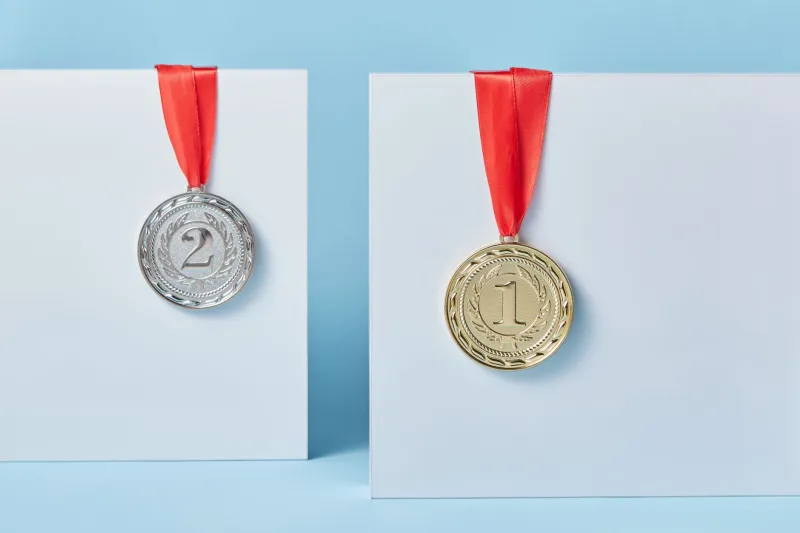
The answer they landed on was medals — but not the tiered gold-silver-bronze system we know today. In 1896, first-place finishers received a silver medal and an olive branch. Second place got a bronze medal and a laurel branch. Third place got nothing officially recognized.
The gold-silver-bronze podium structure we now consider completely standard wasn't established until the 1904 Games in St. Louis. Even then, the medals were often given out weeks or months after competition ended, and their design varied wildly from Games to Games.
For the first few decades of the modern Olympics, medals were meaningful symbols but not particularly valuable objects. They were made of relatively modest materials, often fairly small, and not always immediately recognizable as major awards to anyone outside the Olympic community.
The Design Era
As the Games grew through the mid-twentieth century, medal design became increasingly intentional. The iconic image of Nike, the Greek goddess of victory, on the obverse of Olympic medals became standardized from 1928 onward, establishing a visual continuity that connected the modern Games to their ancient origins.
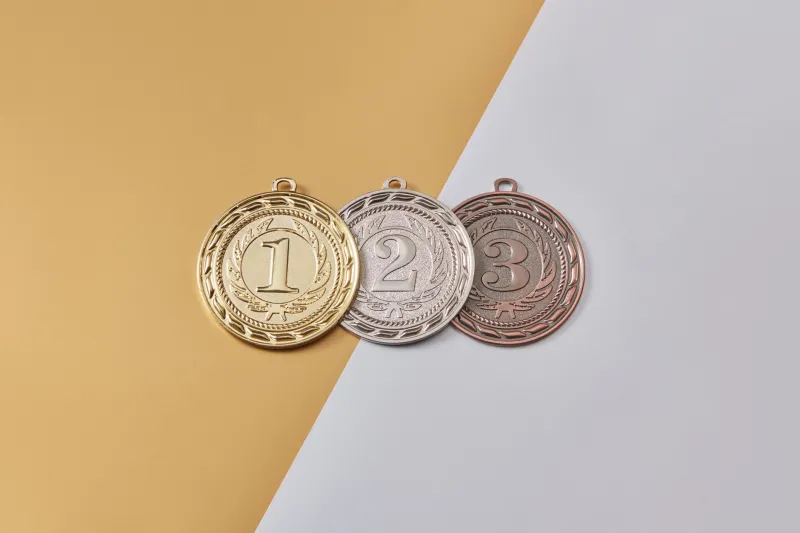
Here's a fact that surprises most people: Olympic gold medals haven't actually been made of solid gold since the 1912 Stockholm Games. Current regulations require gold medals to be made of at least 92.5% silver and plated with a minimum of six grams of gold. The 2024 Paris Olympics made headlines for embedding a piece of original iron from the Eiffel Tower into each gold medal — a design choice that added symbolic weight while keeping material costs manageable.
The medals themselves, by raw material value, are worth a few hundred dollars at most. Yet they sell at auction for hundreds of thousands.
When Hardware Became an Asset
The American sports market has a particular relationship with Olympic medals that goes well beyond sentiment. Jesse Owens' medals. Mark Spitz's collection. These objects have become primary-source artifacts of cultural history, and the market prices them accordingly.
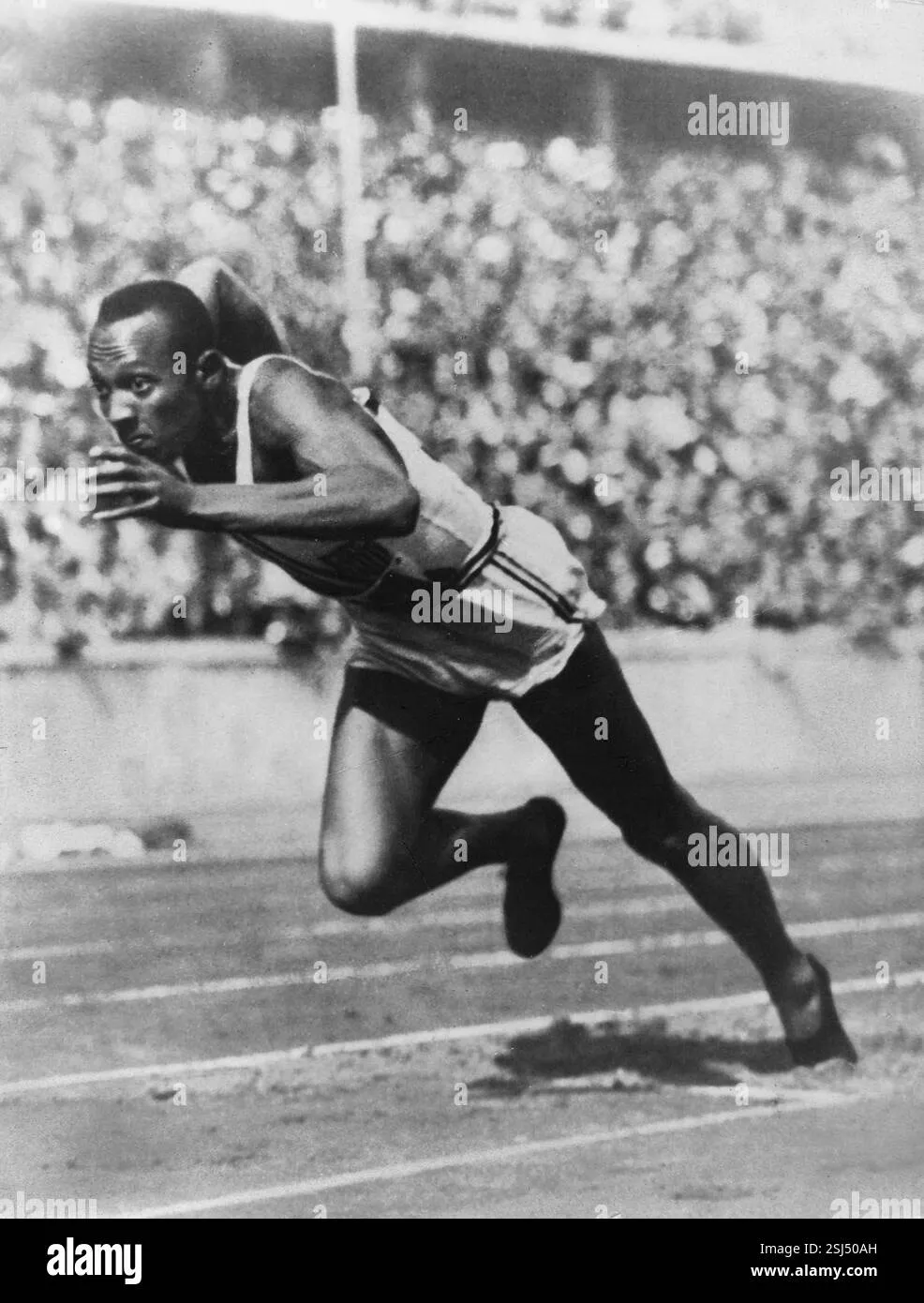 Photo: Jesse Owens, via c8.alamy.com
In 2013, one of Jesse Owens' gold medals from the 1936 Berlin Olympics sold at auction for $1.47 million. Cassius Clay's 1960 light heavyweight gold medal — reportedly thrown into a river by the future Muhammad Ali after he was refused service at a Louisville restaurant — would be considered essentially priceless if it ever surfaced.
This is a genuinely strange situation when you step back and look at it. The ancient Greeks were philosophically opposed to putting a dollar figure on athletic achievement. The olive wreath was intentionally worthless as a commodity so that its symbolic value remained pure. The modern American market has done almost the exact opposite — it has assigned extraordinary financial value to symbols of achievement, which in a way reflects how deeply athletic excellence is embedded in American cultural identity.
Winning an Olympic gold medal in the US doesn't just mean you're the best in the world. It means you're potentially set for life, between the medal's auction value, the endorsement deals it unlocks, and the speaking circuit it opens up.
What the Hardware Actually Tells Us
The shift from olive wreath to auctionable artifact isn't a story of corruption or lost values — it's a story of how culture scales. The ancient Greeks could maintain the purity of symbolic reward in a world where the Games involved a few thousand athletes and spectators from a relatively contained geographic area. Once the Olympics became a global television event watched by billions, the economic forces at work were simply too large for that model to survive.
What has remained constant — across 2,800 years and every material change — is the fundamental human need to mark exceptional achievement with something tangible. Whether it's leaves from a sacred tree or a silver disc dipped in gold, we have always needed to hold something in our hands and say: this is what winning looks like.
The object changes. The impulse never does.