Five Events, One Legend: How the Ancient Greek Pentathlon Stacks Up Against Today's All-Around Athlete
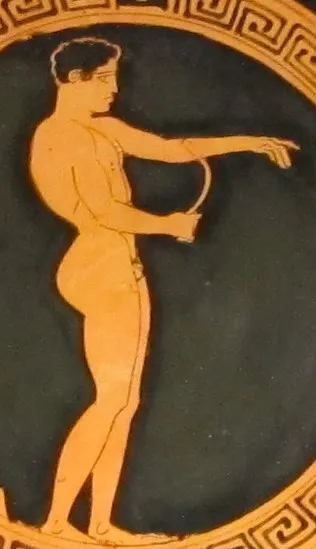
Photo: RickyBennison, CC BY-SA 3.0, via Wikimedia Commons
Five Events, One Legend: How the Ancient Greek Pentathlon Stacks Up Against Today's All-Around Athlete
In ancient Greece, if you wanted to be called the best athlete in the world, winning one event wasn't enough. You had to be the best at five. The ancient Olympic pentathlon — a single-day gauntlet combining discus, javelin, long jump, running, and wrestling — was considered the truest test of human athletic excellence. The winner wasn't just fast or strong. He was everything.
More than 2,700 years later, the idea of a complete athlete still captivates sports fans. But the way we define "complete" has changed dramatically. So let's go back to the beginning and ask a genuinely interesting question: Was the ancient Greek pentathlete actually tougher than today's all-around champion?
What Happened at Olympia
The pentathlon first appeared at the ancient Olympics in 708 BC, roughly 68 years after the Games themselves began. It was introduced alongside wrestling as a new way to honor Zeus — not through a single feat, but through a full demonstration of physical mastery.
The five events were contested in a specific order: discus throw, long jump, javelin throw, a foot race (the stadion, roughly 200 meters), and wrestling. The exact scoring system remains debated among historians, but it's widely believed that winning three of the five events secured the overall victory. Some scholars argue that early leaders could be eliminated before the final wrestling bout, making tactical performance — not just raw ability — a key part of the competition.
What's striking is how deliberately varied the events were. The discus and javelin tested upper-body power and technique. The long jump demanded explosive leg strength and coordination. The stadion required pure speed. And wrestling, saved for last, called for endurance, leverage, and mental toughness. The Greeks weren't looking for a specialist. They were looking for a human being who had developed every physical quality to a high level.
The Long Jump Was Not What You Think
Here's where things get fascinating — and where the ancient pentathlon starts to look genuinely strange by modern standards. The Greek long jump, called the halma, was performed with hand-held weights called halteres. Athletes swung these weights forward during takeoff and dropped them behind their heels at the peak of flight, theoretically adding distance to the jump.
Ancient records suggest some athletes achieved distances that seem almost impossible — one account credits a jumper named Phayllos with a leap of over 55 feet. Modern biomechanics researchers have largely dismissed those numbers as exaggerated, but the use of halteres does appear to have been a genuine technique rather than myth. Whether it actually helped or was more ritual than science, nobody knows for certain.
The modern long jump, by contrast, is pure speed-to-power conversion — a sprint down a runway followed by a perfectly timed plant and flight. The world record stands at 29 feet 4 inches, set by Mike Powell in 1991. Clean, measurable, and ruthlessly precise.
From Five Events to Seven — and Beyond
The modern Olympic Games don't feature a direct successor to the ancient pentathlon. What they do have is the modern pentathlon — but don't let the shared name fool you. Introduced at the 1912 Stockholm Games by Pierre de Coubertin, the modern version includes fencing, freestyle swimming, show jumping, pistol shooting, and cross-country running. It was designed to simulate the skills of a 19th-century military courier. The ancient Greeks would have had no idea what to make of it.
If you're looking for the closest modern equivalent to what the Greeks actually valued, the decathlon is probably the better comparison. Ten events across two days, combining sprints, jumps, throws, and middle-distance running, the decathlon has been called the ultimate test of athletic versatility since it entered the Olympics in 1912. American athletes have dominated the event historically — from Bob Mathias and Rafer Johnson to Dan O'Brien and Bryan Clay.
But even the decathlon, with all its demands, is built around a scoring table that rewards specialists. A decathlete can post a weak discus throw and make up the points elsewhere. In the ancient pentathlon, there's reason to believe a truly lopsided performance could cost you the whole competition.
Training Then vs. Training Now
Ancient Greek athletes trained in the gymnasium and the palaestra — open-air facilities where they practiced their events daily under the guidance of a trainer called a paidotribes. Their preparation was serious and structured by the standards of the time, but it had no concept of periodization, no understanding of muscle fiber recruitment, and no sports nutrition beyond olive oil, figs, and the occasional meat-heavy meal.
A modern all-around athlete operates in a completely different universe. Today's decathletes work with biomechanics coaches, strength and conditioning specialists, sports psychologists, and nutritionists. They use GPS tracking, force plates, video analysis, and heart rate variability data to optimize every training session. Recovery science alone — sleep protocols, cryotherapy, load management — would have seemed like sorcery to an ancient Greek trainer.
The result is athletes who are objectively more capable in almost every measurable way. The winning 200-meter time at the 1896 Athens Olympics was 22.2 seconds. Today's elite sprinters run it in under 20. Discus throws that would have shattered ancient Greek records are now routine in high school track meets.
So Who Was the Better Athlete?
It depends entirely on what you mean by "better." If you're measuring output — speed, distance, recorded performance — modern athletes win in a landslide. That's not a controversial take. It's just what happens when you add a century of sports science to the equation.
But the ancient pentathlete was doing something arguably more impressive given the context. Without any of the infrastructure that modern athletes take for granted, Greek competitors developed five distinct physical skills to a level good enough to compete at the highest event in the ancient world. They trained on instinct, competed without technology, and performed in front of tens of thousands of spectators at a festival that carried enormous religious and cultural weight.
The Greeks believed the pentathlete represented something close to the divine ideal of the human body. Aristotle himself wrote that the pentathlete's physique was the most beautiful of all athletes — not too heavy, not too lean, but perfectly balanced.
That idea — that athletic greatness means being complete, not just elite in one dimension — still echoes through every decathlon competition, every combine workout, every CrossFit competition in America today. The events have changed. The science has exploded. But the question the Greeks were asking in 708 BC is the same one we're still asking now: What does it actually take to be the best all-around athlete in the world?
We've been trying to answer that for a very long time.