9.58 and Falling: How the 100-Meter World Record Broke Itself Across a Century of Sprinting
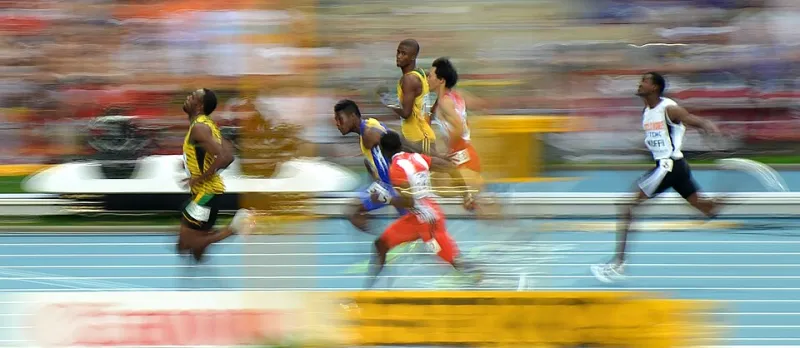
Photo: Tobi 87, CC BY-SA 3.0, via Wikimedia Commons
At some point in the next decade, someone will run 100 meters faster than Usain Bolt. We don't know who. We don't know where. But if history is any guide, it will happen — and when it does, it will be the latest chapter in a story that started more than a century ago on cinder tracks in front of crowds who had no idea they were watching the beginning of the fastest arms race in sports.
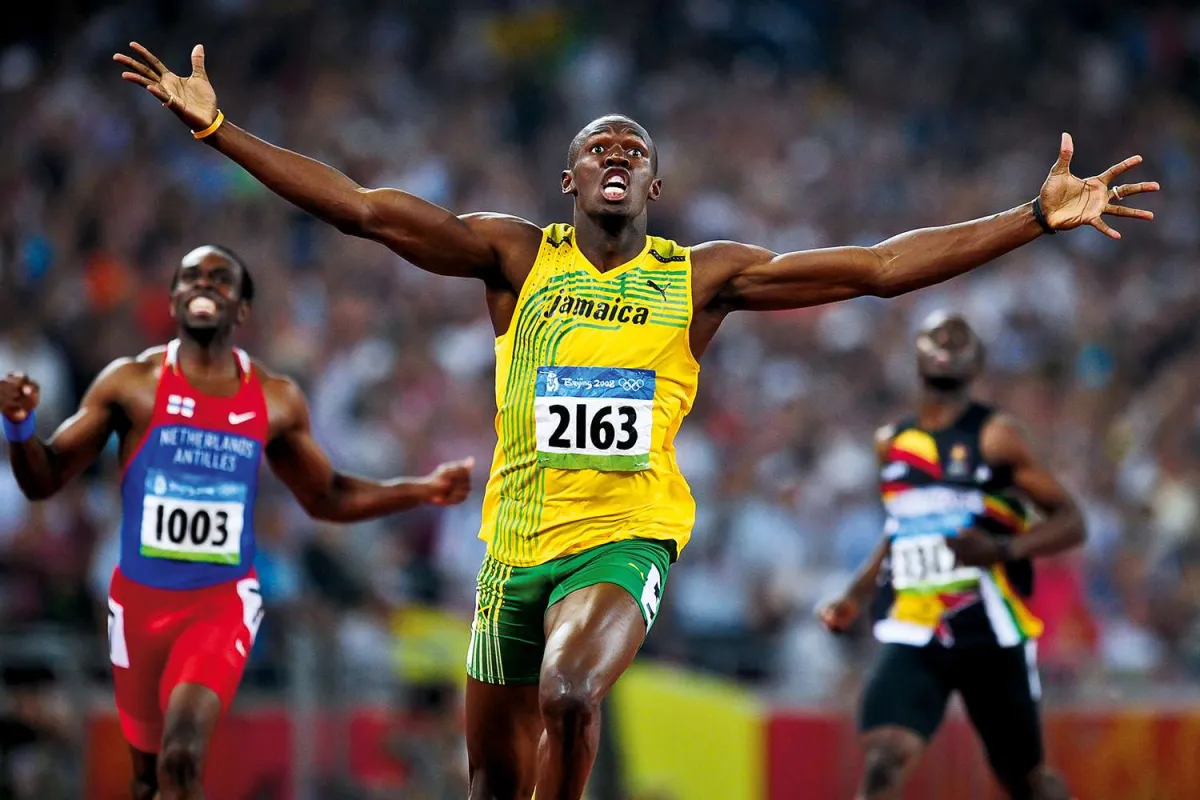 Photo: Usain Bolt, via people.com
The 100-meter world record isn't just a number. It's a timeline of human ambition, technological progress, and athletic evolution. Each new mark reflects the era that produced it — the coaching methods available, the equipment on the athlete's feet, the science behind their training. Let's run through it, decade by decade.
The Early 1900s: Setting the Baseline
The International Amateur Athletic Federation (IAAF), now called World Athletics, didn't begin officially ratifying 100-meter world records until 1912. Before that, times were kept locally and inconsistently, and hand timing made anything faster than a tenth of a second a matter of debate.
The first officially recognized world record was 10.6 seconds, set in 1912. To put that in context: that's roughly the speed of a competitive high school sprinter today. But in 1912, it was the fastest verified time in history. Athletes were training on grass and cinder, wearing leather shoes with minimal spike technology, and working with coaches whose understanding of sprint mechanics was essentially intuitive.
Donald Lippincott of the United States was among the early record holders, and American sprinters would prove to be a dominant force in the event almost from the beginning. The US had a deep pool of competitive track programs, a growing culture of organized athletics, and a university system that was beginning to take sports seriously as both competition and preparation.
The 1920s–30s: Coaching Enters the Picture
Through the 1920s and into the 1930s, the record crept downward in small but meaningful increments. American sprinters like Charlie Paddock — the self-proclaimed "World's Fastest Human" — and later Jesse Owens pushed the boundaries of what hand timing could reliably capture.
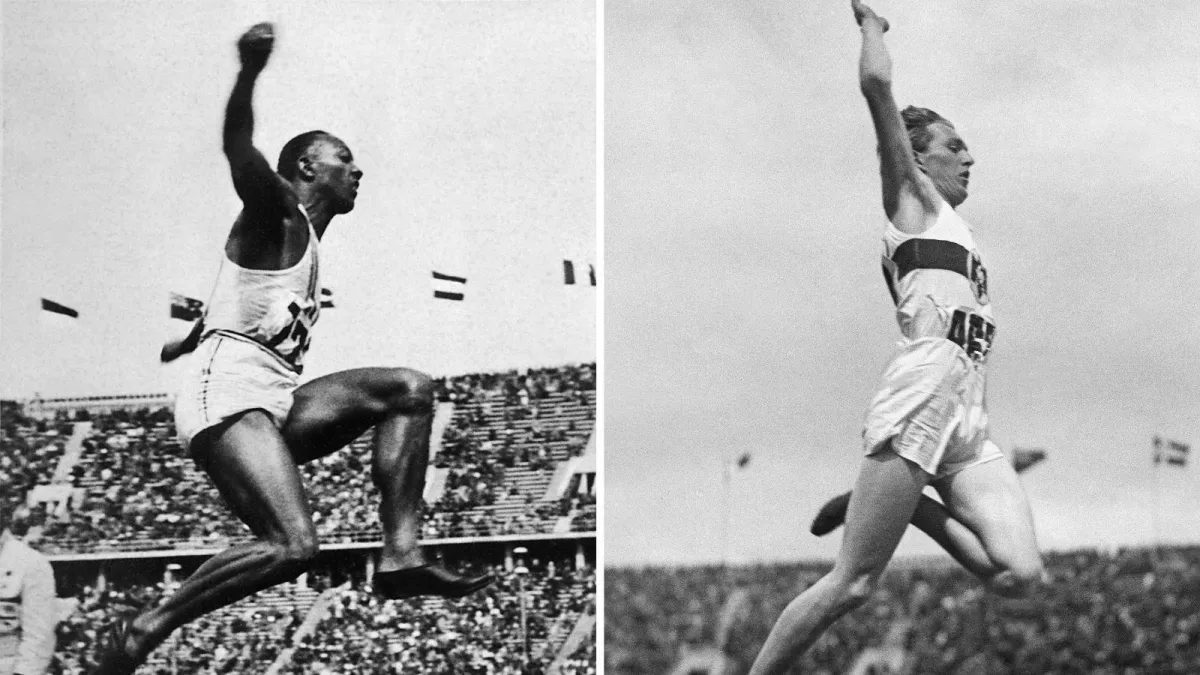 Photo: Jesse Owens, via ichef.bbci.co.uk
Owens is the defining figure of this era. At the 1936 Berlin Olympics, he won four gold medals and ran 100 meters in 10.3 seconds, a time that stood as the world record for two decades. What made Owens extraordinary wasn't just raw speed — it was the efficiency of his movement. His stride was smooth, his acceleration controlled, and his form remarkably close to what modern coaches teach today. He was, in many ways, ahead of his time without anyone fully understanding why.
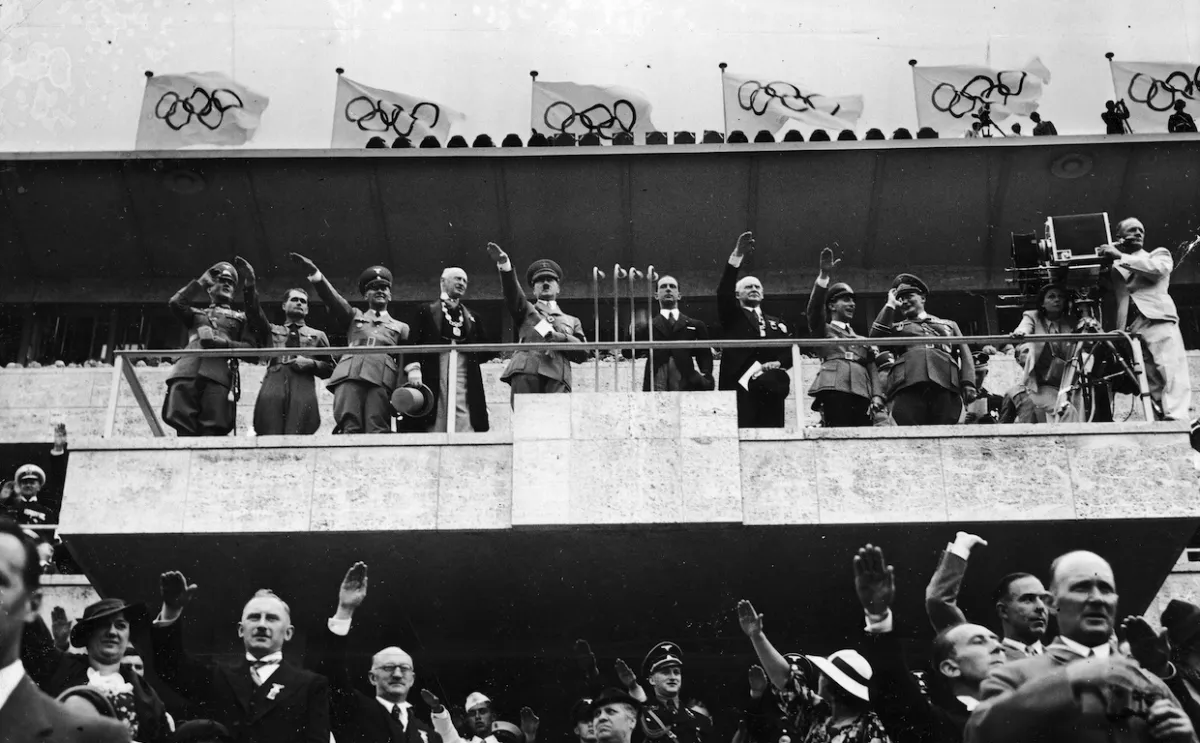 Photo: 1936 Berlin Olympics, via www.jackierobinsonmuseum.org
The era also saw the first serious attempts to analyze sprinting technique. Coaches began using film cameras to study stride patterns, and the idea that speed could be developed — not just discovered — started to take hold.
The 1950s–60s: Breaking the 10-Second Wall
For decades, 10.0 seconds was the psychological barrier in the 100 meters — the sprint equivalent of the four-minute mile. American sprinter Armin Hary of West Germany officially broke it in 1960 with a 10.0 hand-timed run, though American Bob Hayes is widely considered to have been the fastest man of the early 1960s.
Hayes — who went on to win a Super Bowl with the Dallas Cowboys — ran a wind-legal 9.9 at the 1964 Tokyo Olympics. The convergence of better tracks (all-weather synthetic surfaces were beginning to replace cinder), improved starting blocks, and more rigorous training methods was compressing times in ways that felt genuinely shocking to contemporary audiences.
This era also marked the beginning of serious sprint science. Researchers began studying the biomechanics of acceleration, identifying that the first 30 meters of a 100-meter race were as important as the top-speed phase. The idea that sprinting could be broken down into phases — each with its own technical demands — transformed how coaches approached the event.
The 1970s–80s: The Power Era
By the 1970s, strength training had become a standard part of sprint preparation. Sprinters who had previously avoided the weight room for fear of becoming "muscle-bound" were now squatting, deadlifting, and doing plyometrics. The results showed up on the track.
Carlos and Hines had already pushed hand-timed records into the 9.9 range, but the introduction of fully automatic timing (FAT) in the 1970s reset the record books with greater precision. Jim Hines' 9.95 FAT time from the 1968 Mexico City Olympics — the first sub-10 under automatic timing — became the benchmark.
Then came Carl Lewis. The most dominant sprinter of the 1980s, Lewis won the 100-meter gold at the 1984 Los Angeles Olympics and defined an era of American sprint supremacy. His combination of extraordinary acceleration, a late-race surge, and near-perfect mechanics made him the model for a generation of coaches. Lewis would eventually run 9.86 in 1991 — a world record at the time — and his influence on sprint training methodology is still felt today.
The 1990s: The Biomechanics Revolution
The 1990s brought sprint science to a new level. High-speed video analysis, force plate testing, and computer modeling allowed coaches to examine every millisecond of a sprint in detail that had previously been impossible. Researchers identified that elite sprinters applied force to the ground differently than average athletes — not just harder, but in a more horizontal direction that translated directly into forward velocity.
Donovan Bailey of Canada ran 9.84 at the 1996 Atlanta Olympics, setting a world record in front of a home-crowd-adjacent American audience that made the performance feel like a gut punch and a revelation at the same time. Maurice Greene of the United States responded with 9.79 in 1999, a record that seemed almost untouchable.
It wasn't.
The 2000s–Present: The Bolt Era and Beyond
Asafa Powell pushed the record to 9.74 in 2007. Then Usain Bolt happened.
Bolt's 9.69 at the 2008 Beijing Olympics — run while he was visibly celebrating before crossing the finish line — sent sports scientists scrambling. His 9.58 in Berlin the following year remains the world record today. At 6-foot-5, Bolt defied every biomechanical assumption about ideal sprinter body type. His stride length was extraordinary, his acceleration phase was slower than his rivals', and yet he was faster than anyone who had ever lived.
The debate about what comes next is genuinely fascinating. Some researchers believe we're approaching the physical limits of human sprinting. Others point to advances in shoe technology — the same carbon-fiber plate innovations that transformed marathon running — as a potential source of future gains. Others still argue that the global expansion of elite track programs, particularly in Africa and the Caribbean, means the talent pool is still growing.
The Record That Never Stops Moving
From 10.6 to 9.58 in a little over a century. That's more than a full second shaved off the fastest human sprint, driven by coaching innovation, equipment improvement, nutrition science, and the simple fact that more people are competing at the highest level than ever before.
The 100-meter world record is, in a way, a report card on human progress. Every time it falls, something has changed — in the lab, in the weight room, on the track, or in the mind of an athlete who decided the current limit wasn't actually a limit at all.
Somebody out there is training right now to prove that point again.