The Race That Owns America: Why the Mile Refused to Die in a Metric World
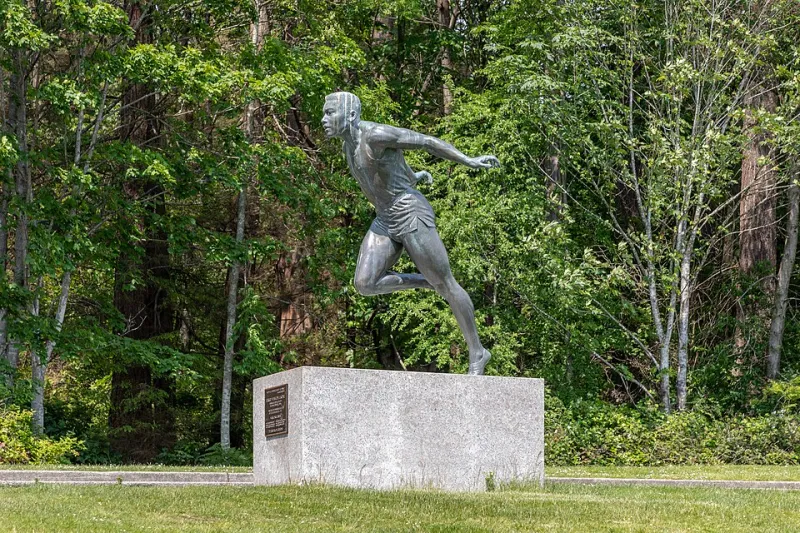
Photo: Dietmar Rabich, CC BY-SA 4.0, via Wikimedia Commons
There is no mile race at the Olympics. There never has been. And yet, ask any casual American sports fan to name a legendary running distance, and odds are they'll say the mile before they ever mention 1,500 meters. That's a strange thing when you think about it — a distance that doesn't exist on the world's biggest athletic stage somehow became the most iconic number in American running culture.
So how did that happen? And why, decades into a metric-dominated Olympic era, does the mile still hold a grip on American athletics that no governing body has managed to loosen?
A Measurement Born in Rome, Refined in Britain
The mile's story doesn't begin in the United States. It begins, of all places, with the Roman army. The Latin phrase mille passuum — a thousand paces — described the distance a Roman legionnaire would cover in one thousand double-steps, roughly 4,860 feet. The British eventually adopted and adjusted it, landing on the 5,280-foot statute mile that became standard across the English-speaking world.
When British colonists arrived in America, they brought that measurement with them the same way they brought their language and their legal systems. By the time organized athletics started taking shape in the mid-1800s, the mile was already baked into how Americans thought about distance — on roads, on land deeds, and eventually on running tracks.
Early American track meets in the 1860s and 1870s naturally gravitated toward the mile as a prestige event. It was long enough to require real endurance, short enough to deliver genuine drama, and it carried the weight of a shared cultural measurement that everyone instinctively understood. A quarter mile, a half mile, a full mile — these divisions made intuitive sense to American audiences in a way that 400 meters or 1,500 meters simply didn't.
The Olympics Said No
When Pierre de Coubertin revived the Olympic Games in 1896, the athletic program was largely built around metric distances. The 1,500 meters became the middle-distance flagship event — close to the mile, but not quite. At roughly 120 yards short, it's a meaningfully different race, one that rewards a slightly different kind of athlete and produces slightly different tactical battles.
America adapted, because it had to. Olympic glory required competing in metric events, and American runners became world-class at 1,500 meters. But back home, the mile never went anywhere. College track programs kept it. Indoor meets kept it. The whole cultural apparatus of American running continued to treat the mile as the real thing, with 1,500 meters feeling like a slightly awkward substitute.
The tension between those two worlds has defined American middle-distance running for more than a century.
Four Minutes Changed Everything
If one moment cemented the mile's permanent place in American sports consciousness, it was May 6, 1954 — the day Roger Bannister ran the first sub-four-minute mile in Oxford, England. Bannister's 3:59.4 wasn't an Olympic record. It wasn't even set at a major championship. It was a time trial at a modest meet on a windy afternoon.
And yet the four-minute mile became one of the most universally recognized athletic barriers in history. Americans embraced it with particular intensity. Within months, runners on both sides of the Atlantic were chasing the barrier Bannister had broken. By the 1960s, American milers like Jim Ryun were household names in a way that 1,500-meter specialists rarely became.
Ryun's world record of 3:51.1, set in 1967, stood for nearly a decade. He competed at the Olympics in the 1,500 meters, as all American milers were forced to do, but his legend was built on the mile. The same was true for Steve Scott, who ran the mile under four minutes more than 100 times in his career. And for Alan Webb, who broke Ryun's American mile record in 2007 with a stunning 3:46.91 — a performance that generated more mainstream coverage than almost any metric track result that year.
Why Metric Never Won the Cultural Argument
The United States made a halfhearted attempt at metrication in the 1970s, and it failed spectacularly in everyday life. Americans kept measuring their height in feet and inches, their speed in miles per hour, and their running distances in miles. The metric system won in science labs and pharmaceutical packaging, but it never conquered the street corner or the school track.
That stubbornness had a direct impact on athletics. While the rest of the world naturally thought in kilometers and meters, American runners grew up training for mile runs in gym class, reading about four-minute mile attempts in the sports pages, and watching high school mile races at state championships. The distance was sewn into the fabric of American athletic identity before the Olympic program ever had a chance to replace it.
Indoor track — which operates on a slightly different calendar and under different governing structures — helped keep the mile alive at the elite level. The Millrose Games in New York City, one of the most prestigious indoor meets in the world, has featured a featured mile race for decades. Winning the Wanamaker Mile at Millrose carries genuine prestige among American runners in a way that winning a random 1,500-meter heat simply does not.
The Distance That Mirrors America
There's something fitting about the mile's place in American sports culture. It's a measurement that doesn't fit neatly into the global system, one that the rest of the world long ago moved past, and yet Americans have held onto it with a kind of cheerful defiance that feels entirely on brand.
The mile is not the most practical distance. It's not the most scientific. It doesn't map cleanly onto the Olympic program. But it carries a story — from Roman legions to British colonists to Jim Ryun on a Kansas track in 1967 to high school kids running their first sub-five-minute mile — that no governing body can legislate away.
The Olympics will keep running the 1,500 meters. American runners will keep competing in it and winning it. But when a kid in Indiana laces up their spikes for the first time and dreams about breaking a record, they're almost certainly dreaming in miles.
Some distances just belong to a place. The mile belongs to America.