Every Four Years: The Ancient Clock That Still Runs Elite Sport

Ask any elite American sprinter, swimmer, or gymnast what year it is, and there's a decent chance they'll give you a number that has nothing to do with the calendar on the wall. For them, time runs differently. It runs in four-year blocks — a rhythm set not by modern sports science, but by a religious festival held in a small valley in ancient Greece nearly three thousand years ago.
The Olympiad, as the Greeks called it, was the standard unit of time measurement in the ancient world. The four-year gap between Games wasn't chosen arbitrarily. It aligned with the agricultural calendar, with religious observances honoring Zeus, and with the practical reality of travel across the Greek world. But somewhere along the way, it became something more than a scheduling decision. It became the heartbeat of competitive sport itself.
And here's the thing: we never really questioned it.
Where the Cycle Came From
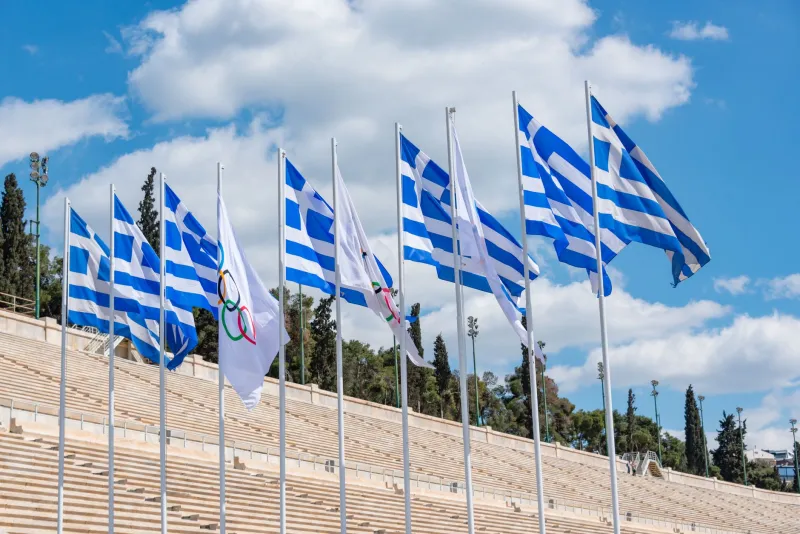
The earliest Olympic Games, held in 776 BC in Olympia, Greece, were not primarily a sporting event in the way we understand sport today. They were a sacred gathering — a truce between warring city-states, a moment of collective devotion, and a showcase of human excellence in honor of the gods. The four-year interval between Games gave city-states enough time to prepare athletes, organize delegations, and make the long journey to Olympia on foot or by boat.
For athletes, that four-year window was everything. Training in ancient Greece was not a casual pursuit. Competitors were expected to arrive at Olympia ten months before the Games began, having already spent years preparing under the guidance of trainers called paidotribes. The cycle shaped how they ate, how they trained, and how they understood their own bodies. Winning wasn't just personal glory — it brought honor to your city, tax exemptions, free meals for life, and the kind of social status that money couldn't buy.
The pressure, in other words, was real. And it was organized entirely around that four-year clock.
The Modern Athlete's Four-Year Life
Fast-forward to any American Olympic training center today, and the structure looks remarkably similar — just with better shoes and a sports psychologist on staff. Elite athletes in the US build their entire careers in four-year segments. Coaches periodize training programs to peak at the right moment. Funding from the US Olympic and Paralympic Committee is often tied to Olympic qualification cycles. Sponsorship contracts are structured around Games years. Even athlete retirements tend to fall neatly along these four-year lines.
Take swimming. A swimmer who finishes fourth at the US Olympic Trials doesn't just miss the team — they face a four-year wait to try again. That singular deadline shapes every training decision for the next 1,460 days. The same is true in track and field, gymnastics, wrestling, and rowing. The Olympics function as a forcing mechanism, concentrating years of effort into a single performance window.
Coaches call this "periodization" — the structured manipulation of training volume and intensity over time to produce peak performance at a specific moment. The ancient Greeks didn't have that word, but they understood the concept. Their ten-month pre-Olympic training camp at Elis was essentially the world's first documented periodization program.
What Neuroscience Actually Says
Here's where it gets interesting. Modern sports scientists have spent decades studying how long it takes to develop elite athletic performance. The consensus — built from research on motor learning, muscle adaptation, and cognitive skill acquisition — suggests that meaningful athletic development requires years, not months. Four years turns out to be a biologically reasonable window for significant performance improvement, particularly for athletes in their late teens and early twenties.
Research into long-term athlete development (LTAD) frameworks, widely used by US Olympic sports governing bodies, identifies four-year blocks as natural checkpoints in athletic maturation. This isn't because the ancient Greeks were neuroscientists. It's because the human body's adaptive capacity happens to align reasonably well with a four-year development arc — especially when training is structured and progressive.
That said, some researchers argue the four-year cycle creates as many problems as it solves. Athletes who peak in year two of a cycle face a brutal choice: maintain that level for two more years (which risks burnout and injury) or deliberately hold back (which risks losing competitive edge). The ancient Greek athlete had no such dilemma — there was only one Games, and you either showed up ready or you didn't.
The Career Question
The four-year framework also shapes how American athletes plan their entire careers. A gymnast who makes the team at 16 is already calculating how many cycles she has left before the sport's physical demands become unsustainable. A marathon runner who qualifies at 28 might project two more cycles before age becomes a limiting factor. The Olympiad doesn't just organize training — it organizes life.
This is perhaps the most profound legacy of ancient Olympia. The Greeks invented a competitive structure so logically coherent that it survived the fall of their civilization, the abandonment of the Games for over fifteen centuries, and the total transformation of human society. When Pierre de Coubertin revived the Olympics in 1896, he didn't reinvent the timing. He just picked up where the Greeks left off.
Why It Still Matters
There's a version of this story where the four-year cycle is just inertia — a tradition we've never bothered to change because changing it would be too complicated. And maybe that's partly true. But the evidence suggests something more interesting: an ancient scheduling decision that happened to align with how human athletic development actually works.
The athletes training in Colorado Springs right now, mapping out their path to the next Games, are operating on a timeline first drawn in the dust of a Greek valley nearly three millennia ago. They probably don't think about it that way. But the clock they're running on? It's older than anything else in American sport.