Dirt, Steel, and Explosions: The Long Road to the Modern Starting Block

Imagine you're about to race for the most coveted prize in the ancient world. You've trained for four years. You've walked hundreds of miles to get here. And your pre-race preparation involves kneeling in the sand and digging two small holes in the ground with your fingers.
That was the reality for sprinters competing at the ancient Olympic Games in Olympia, Greece. No blocks, no high-tech gear, no biomechanics coach whispering in your ear about drive phase angles. Just dirt, determination, and whatever grip you could scratch out of the earth before the judge gave the signal.
Fast forward to the 2024 Paris Olympics, where every starting block is wired to a pressure sensor that can detect a false start within a millisecond, and you begin to appreciate just how far this single piece of equipment has traveled across the centuries.
The Stone That Started It All
The ancient Greeks weren't completely improvising. At Olympia, archaeologists have uncovered grooved stone slabs — called the balbis — that served as a fixed starting line. Athletes pressed their toes against the carved grooves to create resistance, giving themselves something to push against at the gun. It was a crude but genuinely clever solution to the fundamental problem of a sprint start: how do you convert explosive muscular energy into forward momentum when the ground keeps sliding away from you?
Those grooves were essentially the world's first starting block. The concept — create a stable surface behind the athlete so their legs have something to drive against — hasn't changed in nearly three thousand years. What has changed is everything else.
When the modern Olympics were revived in Athens in 1896, sprinters had largely abandoned even that level of sophistication. Competitors simply stood at the line or crouched however felt natural. Some dug holes. Some didn't bother. Technique was wildly inconsistent, and nobody had yet done the math on what a proper starting position could actually do for a race time.
The Crouch That Changed Everything
The scientific breakthrough came not from an engineer but from a runner. In the 1880s, an American sprinter named Charles Sherrill began experimenting with a crouching start — dropping low to the ground, both hands touching the dirt, weight loaded over the front foot. His Yale coach reportedly thought it looked ridiculous. Rival athletes called it a gimmick.
 Photo: Charles Sherrill, via people.com
It was neither. The crouching start allowed athletes to generate force at a more efficient angle, driving horizontally rather than fighting gravity by launching vertically. Sherrill's times improved. Other sprinters noticed. By the turn of the twentieth century, the crouch start was standard practice across American track and field.
But there was still a problem. Crouching required something to push against, and that still meant digging. Sprinters at major meets in the early twentieth century would arrive at the track with small trowels or simply use their hands, carving out personal starting holes before every race. Groundskeepers hated it. Race officials tolerated it. Nobody had a better idea yet.
Enter the Block
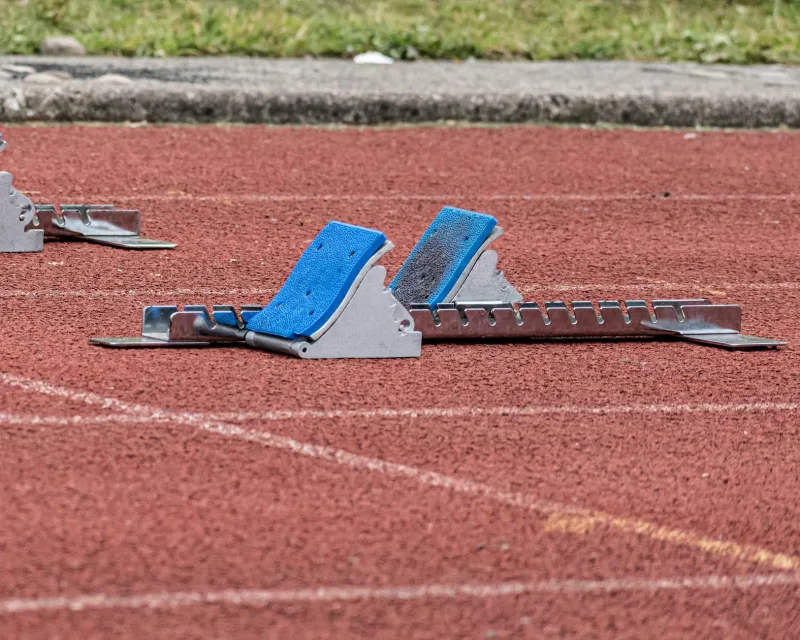
The modern starting block — two angled footplates mounted on a metal frame — was developed in the 1920s and 1930s, with various inventors claiming credit for early versions. By the 1948 London Olympics, starting blocks had become standard equipment at elite competition. The effect on times was immediate and measurable.
With a solid, angled surface to drive against, sprinters could apply maximum force from the very first millisecond of a race. The holes in the dirt had always been imperfect — inconsistent depth, inconsistent angle, affected by weather and track conditions. A steel block didn't shift. It didn't compress. It just pushed back.
American sprinters took to the new technology quickly, and the United States dominated Olympic sprint events through the mid-twentieth century in ways that reflected not just talent but a culture of technical refinement. Coaches began studying film of starts. Angles were measured. The drive phase — those critical first steps out of the blocks — became its own science.
The Electronic Revolution
The next major leap came not from the blocks themselves but from what was built into them. Beginning in the 1990s, governing bodies started integrating false-start detection technology into the block system. Pressure sensors measured the force athletes applied before the starting signal, and timing systems could determine whether a runner had reacted before the gun.
Modern Olympic blocks can detect a reaction time below 100 milliseconds and flag it as a false start — because sports scientists determined that the human nervous system physically cannot process an auditory signal and transmit a motor response any faster than that. If your feet leave the blocks in under a tenth of a second, you weren't reacting. You were guessing.
This technology changed race strategy in subtle but significant ways. Athletes can no longer gain an edge by anticipating the gun. The blocks themselves have become referees.
Today's elite starting blocks also feed data directly to coaches and analysts in real time. Drive angle, force application, time-in-block — all of it is captured and reviewed. A sprinter's start is no longer a feel; it's a measurable, repeatable, improvable mechanical event.
Why It Matters
Every world record in the sprints — from the 100 meters to the 400 — has been set using technology that traces a direct line back to those carved grooves in the stone at Olympia. The problem the ancient Greeks identified, the one they solved with a chisel and some creativity, is the same problem that teams of engineers are still optimizing today.
When Noah Lyles crossed the finish line in Paris last summer, the blocks he exploded out of were the product of nearly three thousand years of accumulated thinking about a single question: how do you help a human being go from zero to full speed as fast as physically possible?
The answer, it turns out, has always been the same. You give them something solid to push against. Everything else is just refinement.