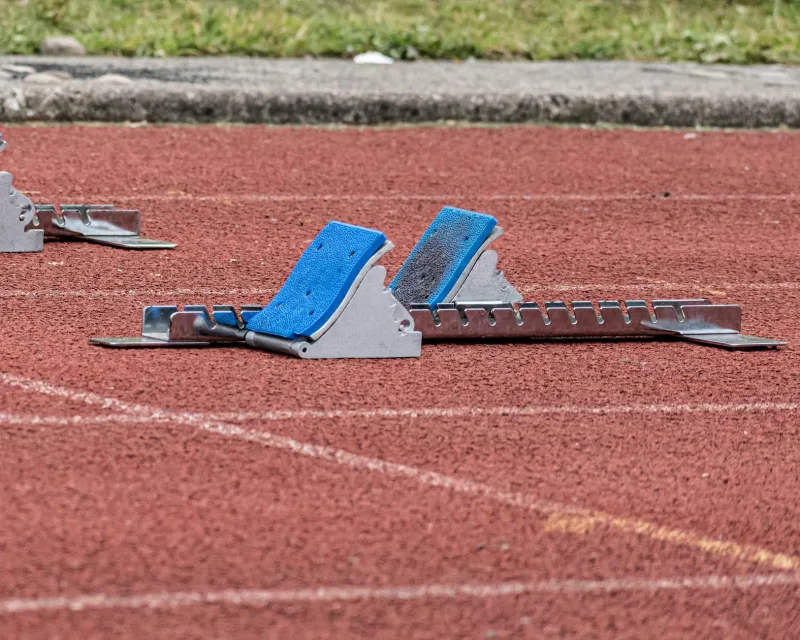
Fast Feet, Faster Times: The Evolution of Racing Shoes From Ancient Greece to Modern Marathons

Running on Sacred Ground
Picture this: it's 776 BC in ancient Olympia, and the greatest athletes in the Greek world are lining up for the stadion race. Their feet are completely bare, gripping the sun-baked earth as they prepare to sprint roughly 200 meters in what would become the world's first recorded Olympic event. No cushioning, no arch support, no traction — just skin against dirt.
These ancient runners weren't missing out on some crucial piece of equipment. They were competing exactly as the gods intended, according to Greek tradition. Athletic nudity, including bare feet, was considered the purest form of competition, stripping away any advantage that wealth or technology might provide.
But here's what's remarkable: those barefoot Greeks were still incredibly fast. Archaeological evidence suggests the best ancient sprinters could cover the stadion in times that wouldn't embarrass a modern high school athlete. The human engine was already impressive — it just needed better wheels.
The First Steps Forward
The transformation began slowly. Roman athletes, never ones to leave tradition untouched, started experimenting with basic leather foot coverings during their adaptation of Greek sports. These weren't really shoes as we'd recognize them — more like protective wrappings that offered minimal cushioning but crucial protection against rough surfaces.
The real breakthrough came in the 1800s, when British athletes began attaching metal spikes to their shoes for better traction on grass tracks. This wasn't just about comfort anymore — it was about performance. Those first spiked shoes gave runners measurably better times, sparking the first serious debates about whether technological aids belonged in "pure" athletic competition.
By the time the modern Olympics launched in 1896, most serious runners wore some form of specialized footwear. The winning marathon time in Athens was 2:58:50 — impressive for the era, but more than 40 minutes slower than today's world record.
The Rubber Revolution
Everything changed in the 1920s when companies like Converse and Keds introduced rubber soles to athletic shoes. Suddenly, runners had real cushioning and significantly better grip. The improvement was immediate and dramatic — track times began falling across every distance.
Jesse Owens dominated the 1936 Berlin Olympics wearing hand-crafted leather spikes with minimal cushioning, but even his revolutionary footwear would seem primitive compared to what came next. The post-World War II boom in synthetic materials opened entirely new possibilities for shoe design.
 Photo: Berlin Olympics, via p4fastel.co.uk
Nike's 1972 Waffle Trainer, inspired by founder Bill Bowerman's experiments with his wife's waffle iron, created a sole pattern that provided unprecedented traction while remaining lightweight. This wasn't just an incremental improvement — it was a fundamental rethinking of how shoes could enhance performance.
Science Meets Speed
The 1980s and 1990s saw athletic footwear become a legitimate science. Companies invested millions in research labs, studying everything from foot strike patterns to energy return mechanics. Air cushioning, gel inserts, and carbon fiber plates began appearing in shoes designed for specific events and running styles.
American distance running experienced a renaissance partly due to these innovations. Suddenly, sub-elite runners were posting times that would have won Olympic medals just decades earlier. The question became: how much of this improvement was human, and how much was technological?
The Super Shoe Controversy
That question reached a boiling point in 2016 when Nike introduced the Vaporfly series, featuring thick foam midsoles and carbon fiber plates designed to return energy with each stride. The performance gains were staggering — studies showed 4-6% efficiency improvements, equivalent to shaving several minutes off marathon times.
Eliud Kipchoge's sub-2-hour marathon in 2019, run in a prototype version of these shoes, ignited fierce debate. Was this human achievement or technological assistance? The controversy echoes ancient Greek concerns about maintaining competitive purity, just with space-age materials instead of bare feet.
 Photo: Eliud Kipchoge, via i0.wp.com
World Athletics eventually regulated super shoe specifications, but the damage — or progress, depending on your perspective — was done. Marathon records fell like dominoes between 2018 and 2022, with virtually every fast time run in some version of these advanced shoes.
The American Advantage
The United States has dominated this technological arms race, with American companies like Nike, Brooks, and Hoka leading innovation. This gives American athletes a crucial advantage — access to cutting-edge footwear often before international competitors.
But it's created new inequalities too. Elite shoes can cost $250 or more, making top-level performance partially dependent on economic resources in ways that would horrify those ancient Greek traditionalists.
What's Next?
Today's running shoes bear almost no resemblance to what athletes wore even 20 years ago. They're lighter, more responsive, and more specialized than ever before. Some marathon shoes now feature multiple carbon plates and foam compounds that didn't exist in nature until scientists created them.
Yet the fundamental tension remains the same one that ancient Greeks grappled with: how do we balance technological advancement with competitive fairness? Those barefoot runners in Olympia were competing in the purest possible form, but they were also potentially limiting human potential.
Modern athletes are faster than ever before, but they're also more dependent on technology than any generation in history. Whether that represents progress or compromise might depend on whether you're trying to break a record or preserve tradition.
One thing is certain: the journey from bare feet on sacred ground to carbon-plated super shoes represents more than just footwear evolution. It's the story of humanity's endless quest to run faster, jump higher, and push the boundaries of what's possible — one step at a time.