When Victory Was a Matter of Opinion: Ancient Greece's Photo Finish Problem
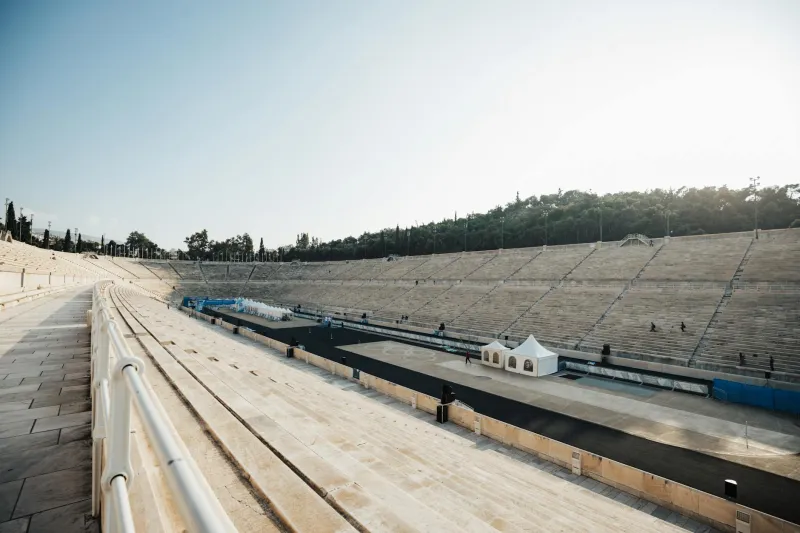
Picture this: two runners charging toward the finish line at Olympia, their bodies straining with every muscle fiber, the crowd roaring so loud it drowns out everything else. They cross the line together—or do they? Without slow-motion replays or laser timing, the ancient Greek judges had to make a call that could change history. And sometimes, they got it spectacularly wrong.
The Human Eye vs. Human Speed
In ancient Greece, determining the winner of a close race fell to a panel of judges called the Hellanodikai—literally "judges of the Greeks." These weren't just any spectators with good eyesight. They were respected citizens, often former athletes themselves, who underwent months of training before the Games. But even the sharpest human eye has its limits.
Consider the stadion, the premier sprint of the ancient Olympics. At roughly 200 meters, it was shorter than today's 200-meter dash, but runners still reached impressive speeds. When two athletes finished within a fraction of a second—what we'd now measure in hundredths—the judges had to rely on their collective judgment and hope they all saw the same thing.
The system worked like this: multiple judges positioned themselves at different angles along the finish line, each making their own determination. If they agreed, great. If they didn't, things got messy fast.
When Judges Disagreed
Historical records from ancient sources reveal that disputed finishes weren't rare curiosities—they were regular headaches. The Greek historian Pausanias wrote about several controversial decisions that sparked everything from heated arguments to outright riots among spectators.
One famous case involved a runner named Eupolemus of Elis, who appeared to edge out his rival in a close stadion race. But the judges were split. Some saw Eupolemus winning clearly, others insisted his opponent had crossed first, and a third group claimed it was too close to call. The debate raged for hours, with supporters of both athletes growing increasingly agitated.
The solution? They declared a tie and awarded olive wreaths to both runners. While this might sound like a modern compromise, it was actually controversial in ancient Greece, where the concept of shared victory went against the competitive spirit that defined Olympic competition.
The Politics of Victory
Close finishes weren't just athletic challenges—they were political powder kegs. Olympic victors returned home to hero's welcomes, lifetime pensions, and statues erected in their honor. A disputed result could affect not just an individual athlete but the prestige of entire city-states.
Some judges faced accusations of bias, especially when athletes from their home regions were involved. The Greeks took these allegations seriously enough that they eventually required judges to swear sacred oaths and undergo purification rituals before the Games. Still, whispers of corruption persisted.
One documented case from the 4th century BC involved a judge allegedly favoring a runner from Athens over a competitor from rival Sparta. The controversy became so heated that it nearly sparked a diplomatic incident between the two city-states. The Olympic organizers eventually instituted a rule requiring judges to be from neutral regions with no athletes competing.
Creative Solutions to an Impossible Problem
Faced with the limitations of human perception, ancient Greeks developed some ingenious workarounds. Some events used multiple finish lines—runners had to cross all of them clearly to claim victory. Others employed a system where judges had to achieve unanimous agreement before declaring a winner.
Perhaps the most interesting solution was the practice of "divine judgment." When human eyes failed, some Greeks turned to religious rituals to determine winners. They'd consult oracles, examine animal sacrifices for signs, or even draw lots—believing that the gods would ensure the rightful champion emerged.
This might sound primitive to modern ears, but it reflects something profound about ancient Greek attitudes toward competition. They understood that perfect accuracy was impossible and that sometimes, accepting uncertainty was better than making a wrong call.
The Technology Revolution
Today's Olympic timing systems can measure differences of 0.001 seconds—roughly the time it takes light to travel 300 kilometers. Photo finish cameras capture thousands of frames per second, creating images so detailed they can determine winners separated by millimeters.
This technology has eliminated the kinds of controversies that plagued ancient competitions. The 2012 Olympic women's 100-meter final, where Shelly-Ann Fraser-Pryce edged Carmelita Jeter by 0.03 seconds, would have been impossible to judge accurately with the naked eye. But modern systems left no doubt about the result.
What Ancient Disputes Teach Us
The ancient Greeks' struggles with close finishes reveal something important about human nature and competition. Even without precise measurements, they understood that sport is ultimately about pushing limits and celebrating excellence. Their willingness to award ties rather than guess at winners shows a wisdom that sometimes gets lost in our modern obsession with definitive results.
More importantly, those ancient controversies helped establish principles that still guide Olympic competition today: the importance of neutral judges, transparent procedures, and the understanding that determining a winner is about more than just crossing a line first—it's about doing so in a way that everyone can accept as fair.
The next time you watch a photo finish at the Olympics, remember those ancient Greek judges squinting in the Mediterranean sun, trying to separate champions from near-champions with nothing but their eyes and their integrity. They may not have had our technology, but they gave us something just as valuable: the understanding that in sport, as in life, the closest calls often reveal the most about who we are.