Sand, Spikes, and Speed: The Long Road to the World's Fastest 100 Meters
Sand, Spikes, and Speed: The Long Road to the World's Fastest 100 Meters
On the evening of August 16, 2009, Usain Bolt crossed the finish line at the World Championships in Berlin and looked at the scoreboard. The number staring back at him — 9.58 seconds — was so absurd that even he seemed briefly confused by it. That time still stands as the 100-meter world record. It is, by any measure, a number that defies easy comprehension.
But here's what makes it even more remarkable: the race Bolt ran that night in Germany traces its DNA back nearly three thousand years, to a strip of flattened earth in the sanctuary of Zeus at Olympia, Greece, where men sprinted barefoot through the summer heat for nothing more than a wreath of olive leaves — and eternal glory.
The sprint is the oldest competitive race in recorded history. And its evolution tells us something profound about how far human athletic achievement has traveled.
The Stadion: Where It All Started
The earliest Olympic Games, held in 776 BC, featured exactly one event: the stadion. Named after the unit of measurement it covered — roughly 192 meters, or about one stadium length — the race was run on a narrow track of packed sand and earth at the sacred site of Olympia. Athletes competed completely naked, oiled up against the sun, with no lanes, no blocks, and no timing devices more precise than the human eye.
The first recorded Olympic champion was a cook named Koroibos of Elis. History doesn't tell us how fast he ran. We know only that he won, and that winning was everything. In ancient Greek culture, athletic victory was a divine gift — evidence that the gods favored you. Second place wasn't a consolation. It was simply losing.
For centuries, the stadion remained the most prestigious event at Olympia. Other foot races were eventually added — including longer distances — but nothing carried the cultural weight of that short, explosive sprint. Speed, in ancient Greece, was the purest expression of human excellence.
The Gap Between Worlds
When the modern Olympics were revived in Athens in 1896, the sprint was reborn with it — this time measured at 100 meters, run on a cinder track, and timed with stopwatches. Thomas Burke of the United States won that inaugural 100-meter final in 12.0 seconds. By the standards of ancient Olympia, he was probably flying. By the standards of what was coming, he was just getting started.
American sprinters would go on to dominate this event for much of the twentieth century, and two names above all others define the arc of that dominance.
Jesse Owens arrived at the 1936 Berlin Olympics as one of the most gifted athletes alive — and left as a symbol of something much larger. Running on a cinder track in front of Adolf Hitler and a crowd of 110,000, Owens won the 100-meter gold in 10.3 seconds, a performance that shattered the idea that any political ideology could define the limits of human potential. His four gold medals in Berlin remain one of the most iconic achievements in Olympic history. Owens ran on grit, raw talent, and a training regimen that would look almost prehistoric compared to what modern sprinters do before breakfast.
Fifty years later, Carl Lewis picked up where Owens left off. Lewis won the 100-meter gold at the 1984 Los Angeles Olympics and again — in one of sport's most dramatic moments — at the 1988 Seoul Games, after Ben Johnson's infamous disqualification. Lewis was the beneficiary of a new era: synthetic rubber tracks, scientifically designed starting blocks, and the early stages of sports science that began treating the human body as an optimizable machine. His winning time in Seoul: 9.92 seconds. The gap between Burke and Lewis tells the whole story of a century's worth of progress.
The Technology That Changed Everything
The single biggest leap in sprint times didn't come from genetics or willpower. It came from the ground beneath the runners' feet.
Cinder tracks, which dominated athletics through the mid-twentieth century, were inconsistent and energy-absorbing. When all-weather polyurethane surfaces — the so-called "mondo" tracks — became standard in the 1970s, times dropped almost immediately. The surface returns more energy to the runner with each stride, effectively giving athletes a fraction of a second back with every step. Across a 100-meter race, those fractions add up.
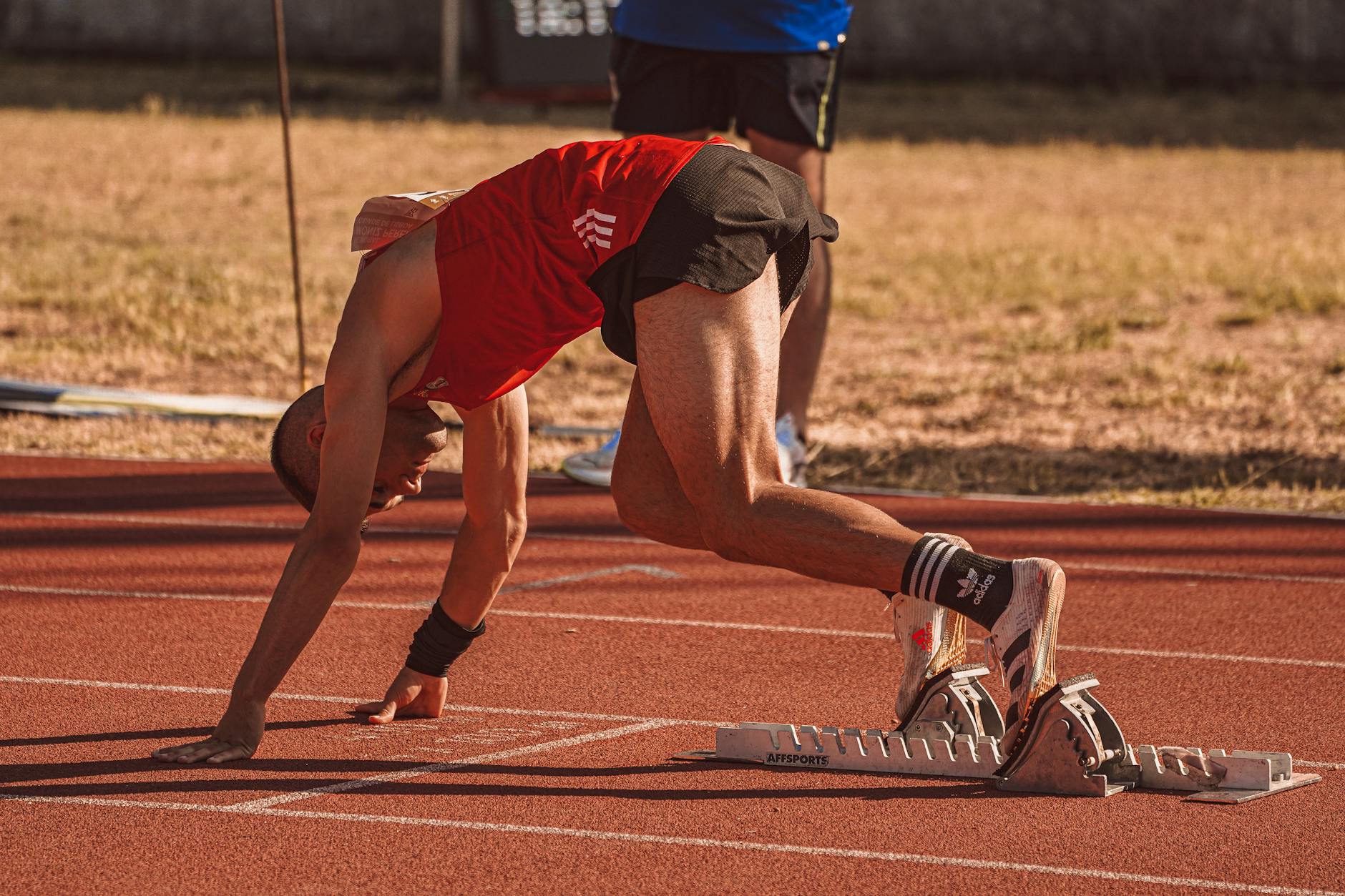
Starting blocks, which became standard in the 1940s, gave sprinters a firm surface to drive against, replacing the hand-dug holes athletes used to scoop into cinder tracks. Lightweight spike shoes evolved from basic leather designs into engineered carbon-fiber instruments. Even the aerodynamics of a sprinter's uniform — skin-tight, seam-minimized — has been studied and refined to reduce drag.
Then came sports science. Modern elite sprinters work with biomechanics specialists who analyze their stride pattern frame by frame. Nutritionists design fueling protocols around training cycles. Recovery technology — from ice baths to altitude training — allows athletes to push harder and bounce back faster than their predecessors ever could. Jesse Owens trained by running. Today's sprinters are managed like precision instruments.
Bolt and the Outer Edge of Possibility
Which brings us back to Berlin, 2009. Usain Bolt didn't just break the world record that night — he broke it by a margin that left physiologists genuinely uncertain about where the ceiling is. His stride length, at over 2.4 meters per step, is physically unusual. His top speed during that race reached approximately 27.8 miles per hour. No human being has been reliably clocked faster.
Scientists have modeled what a theoretically "perfect" 100-meter sprint might look like — optimal reaction time, maximum stride efficiency, ideal conditions — and arrived at estimates somewhere around 9.4 seconds. Whether any human will get there is an open question.
What's not an open question is how far the race has come. From Koroibos padding across packed sand in ancient Olympia, to Burke's 12-second effort on cinder in Athens, to Owens defying history in Berlin, to Lewis rewriting the record books in Seoul, to Bolt making the whole world stop — the 100-meter sprint is a timeline of human ambition written in fractions of a second.
The track got faster. The science got smarter. And somewhere in there, the race became something close to religion.