The Minute That Changed Everything: How the Four-Minute Mile Became America's Greatest Sports Obsession
For nearly a century, the four-minute mile stood as athletics' most tantalizing barrier. Not the fastest sprint or the longest jump, but a single lap around the track four times in under 240 seconds. To understand why this particular milestone consumed American sports culture in the early 1950s, you need to understand just how impossible it seemed.
When Science Said "Never"
In 1945, Swedish physiologist Gunnar Hägg declared the four-minute mile beyond human capability. His calculations were precise: the human cardiovascular system simply couldn't deliver enough oxygen to sustain the required pace. American sports scientists agreed. The barrier wasn't just psychological—it was biological.
Yet American runners kept getting closer. In 1943, Sweden's Arne Andersson had run 4:01.6. By 1945, Hägg himself had lowered the record to 4:01.4. Each fraction of a second felt monumental, but that final 1.4 seconds might as well have been a mile itself.
America's Mile Men
While European runners dominated the record books, American milers captured the nation's imagination through sheer determination. Wes Santee, a Kansas farm boy who trained on dirt tracks, became America's great hope. In 1954, he ran 4:00.5—tantalizingly close but still on the wrong side of history.
Santee's rivalry with Australia's John Landy turned the four-minute chase into international drama. American newspapers tracked their training regimens like military campaigns. Sports Illustrated, launched in 1954, made the four-minute mile one of its earliest obsessions, understanding that this quest perfectly embodied the American spirit of pushing boundaries.
The psychological weight was enormous. Runners would pace themselves conservatively through three laps, then discover they needed an impossibly fast final quarter-mile. The mathematics were cruel: to break four minutes, you needed to average 60 seconds per lap. Miss that pace by just two seconds per lap, and you'd finish in 4:08—respectable, but not historic.
The English Doctor Who Changed Everything
Roger Bannister wasn't supposed to be the one. The 25-year-old medical student from Oxford trained just 30 minutes a day, fitting workouts between hospital rounds. American runners like Santee were full-time athletes with sophisticated training programs. But on May 6, 1954, at Oxford's Iffley Road track, Bannister ran 3:59.4.
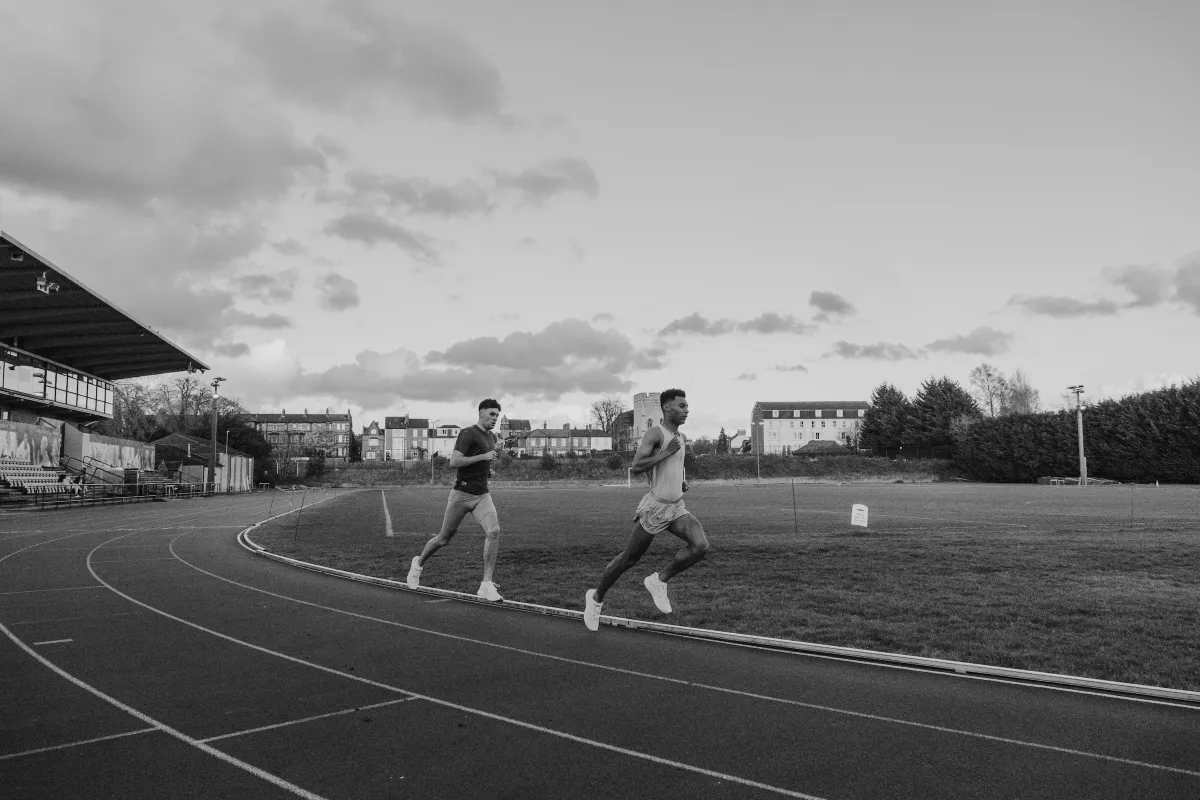 Photo: Iffley Road track, via d2kq0urxkarztv.cloudfront.net
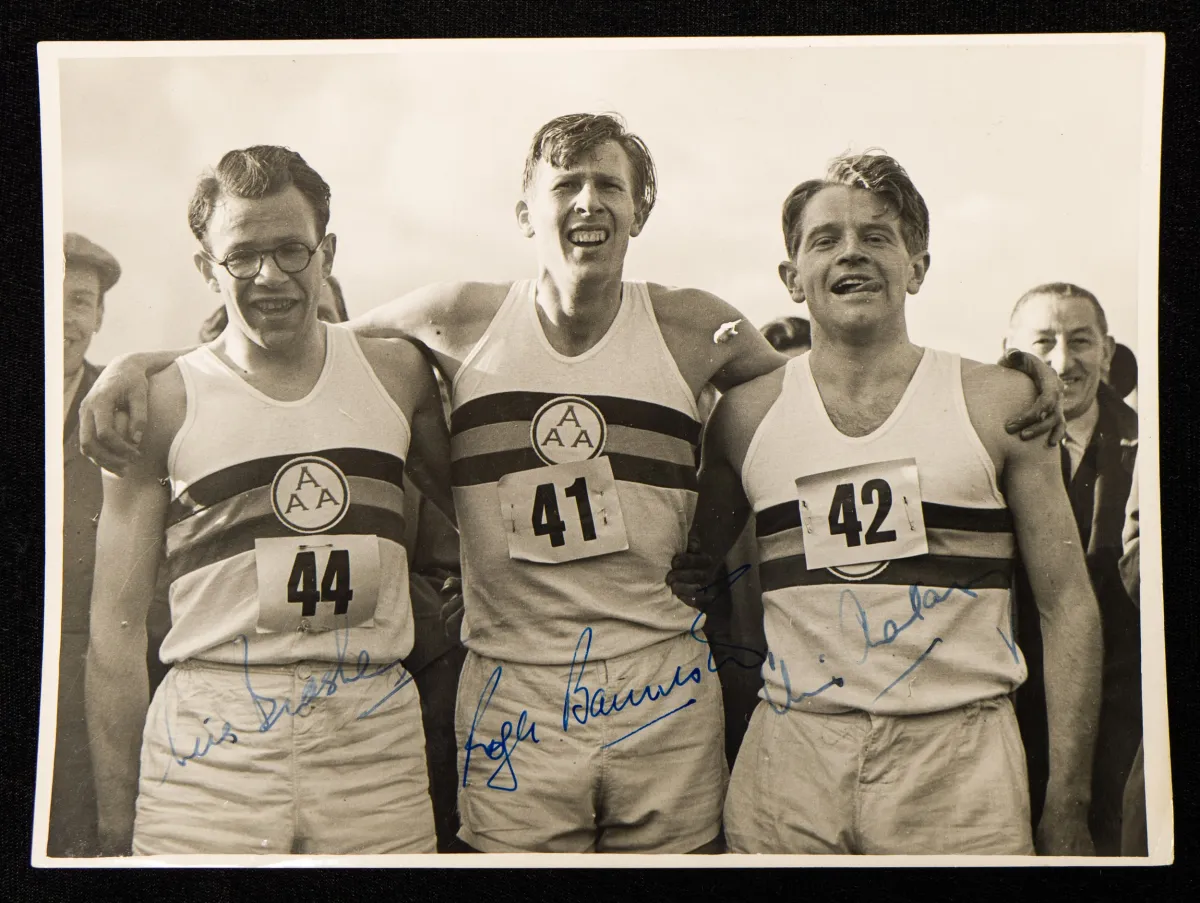 Photo: Roger Bannister, via images.squarespace-cdn.com
The announcement came in that peculiar British way: "The time was three minutes..." A pause. The crowd held its breath. "...fifty-nine point four seconds." Pandemonium.
American sports media was stunned. How had a part-time athlete achieved what their best professionals couldn't? The answer lay partly in Bannister's scientific approach—he was, after all, studying to become a neurologist—and partly in perfect conditions and pacing.
The Floodgates Open
Bannister's breakthrough proved the barrier was indeed psychological. Just 46 days later, John Landy ran 3:58.0, becoming the second man under four minutes. By the end of 1954, several runners had joined the sub-four club. The "impossible" had become merely very difficult.
Wes Santee finally broke through in 1955, running 3:58.2 and becoming the first American to crack the barrier. His achievement felt like national vindication—proof that American grit could match European elegance.
Why the Mile Mattered to America
The four-minute mile captured American imagination because it represented the perfect intersection of individual achievement and measurable progress. Unlike team sports or subjective competitions, the mile was pure: one man, one track, one clock.
It also embodied the American belief that any barrier could be broken with enough determination. The fact that experts had declared it impossible only made the quest more appealing. This was the nation that had just fought World War II and was beginning to eye the moon.
The mile's imperial measurement added to its appeal for American audiences. While the rest of the world was moving toward metric, the mile remained defiantly familiar—four laps of a quarter-mile track, a distance every American could visualize.
The Modern Mile
Today's mile world record stands at 3:43.13, set by Morocco's Hicham El Guerrouj in 1999. What once seemed impossible now seems almost pedestrian—high school athletes regularly break four minutes, and elite college runners consider it a basic benchmark.
But the four-minute mile's cultural significance transcends its athletic achievement. It proved that perceived limits often exist only in our minds. When Bannister crossed that finish line in 3:59.4, he didn't just run fast—he expanded human possibility.
The phrase "four-minute mile" entered American vocabulary as shorthand for breakthrough achievement. Business leaders invoke it when discussing innovation barriers. Scientists reference it when explaining paradigm shifts. It became a metaphor for the moment when impossible becomes inevitable.
The Timeline's Lesson
Looking back through the lens of sports history, the four-minute mile represents a unique moment when athletic achievement transcended sport itself. It wasn't just about running faster—it was about proving that human limitations are often self-imposed.
Bannister's 3:59.4 lasted as a record for just 46 days, but its impact endures seven decades later. In an era when sports records fall regularly and performance improvements seem incremental, the four-minute mile reminds us that sometimes, breaking through requires not just physical training, but the courage to believe the impossible might actually be possible.
The ancient Greeks would have understood this perfectly. They, too, believed that athletic achievement could transcend the merely physical and touch something greater. The four-minute mile proved them right—one minute at a time.