10 Ancient Olympic Events That Changed Sports Forever (And a Few That Probably Should Have Stayed Buried)
10 Ancient Olympic Events That Changed Sports Forever (And a Few That Probably Should Have Stayed Buried)
American sports culture loves its origin stories. We know who threw the first forward pass, who invented basketball in a Massachusetts gym, and roughly when baseball stopped being a gentleman's pastime and became a national obsession. But the deepest roots of organized athletic competition don't start in the United States at all — they start in a dusty valley in ancient Greece, sometime around 776 BC.
The ancient Olympic Games weren't just a sports festival. They were a religious ritual, a political statement, and a proving ground for human capability. And the events they featured? Some of them are still with us. Others were so extreme they make modern combat sports look like a yoga class.
Here are ten ancient Olympic disciplines — where they came from, what they looked like, and what became of them.
1. The Stadion (Sprint Race)
What it was: The original Olympic event — a straight-line sprint of roughly 192 meters down a packed dirt track. For the first 13 Olympic Games, it was the only event.
How it worked: Athletes ran barefoot, often unclothed, from one end of the stadium to the other. The winner had his name used to title that entire Olympiad.
Modern legacy: Every 100-meter and 200-meter race you've ever watched traces directly back to this. The stadion is the ancestor of the sprint, full stop. When American high schoolers run the 100-meter dash at their state championships, they're participating in a tradition nearly 3,000 years old.
2. The Diaulos (Double Sprint)
What it was: Introduced around 724 BC, the diaulos was essentially two lengths of the stadium — a there-and-back sprint of roughly 400 meters.
How it worked: Runners reached the far end of the track, turned around a post, and came back. The turn was notoriously difficult and wiped out more than a few leaders.
Modern legacy: The 400-meter dash. One of the most grueling events in track and field — too long to sprint flat out, too short to pace — the 400 has roots in this ancient double-length race. American athletes have historically dominated this event at the Olympics.
3. The Dolichos (Long-Distance Race)
What it was: The marathon of the ancient Games — a long-distance foot race estimated to cover anywhere from 7 to 24 laps of the stadium, depending on the era.
How it worked: Endurance over speed. Athletes who excelled at the dolichos were built differently from sprinters — leaner, more efficient. Sound familiar?
Modern legacy: The 5,000 and 10,000-meter track events. Distance running as a competitive discipline starts here. American distance runners like Galen Rupp and Shalane Flanagan are the spiritual descendants of ancient dolichos competitors.
4. The Discus Throw
What it was: One of the five disciplines of the ancient pentathlon, the discus throw involved hurling a heavy stone or bronze disc as far as possible.
How it worked: Ancient discuses varied wildly in weight — somewhere between 3 and 9 pounds depending on the competition — and athletes threw from a small platform rather than a modern throwing circle.
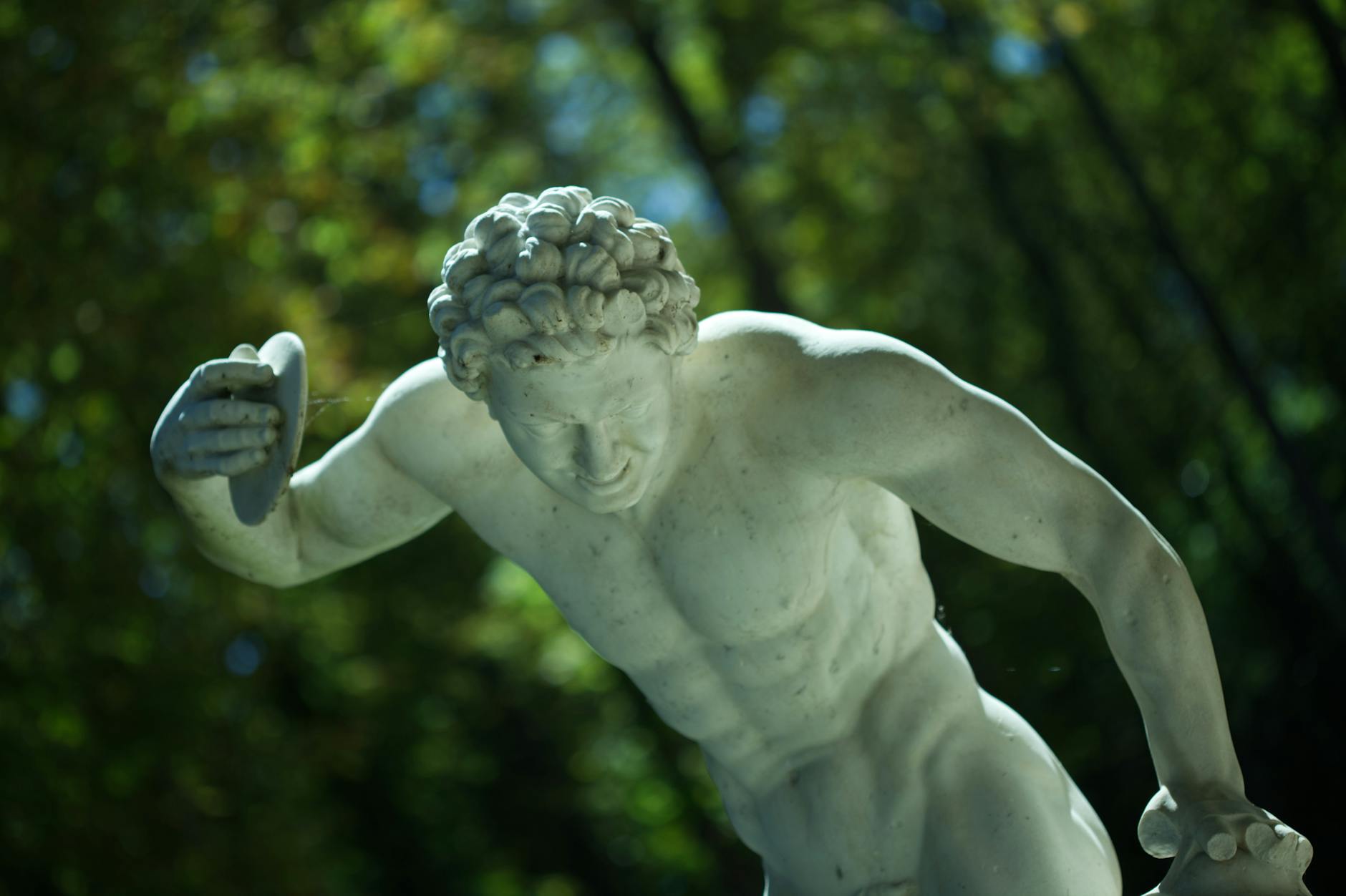
Modern legacy: The discus throw is still an Olympic event today, essentially unchanged in concept. It's also one of the most popular throwing events in American high school and college track programs. Myron's famous sculpture Discobolus — a Greek athlete mid-throw — remains one of the most iconic images in all of sports history.
5. The Javelin Throw
What it was: Another pentathlon staple, the javelin was thrown for both distance and, in some versions, accuracy.
How it worked: Athletes used a leather thong looped around the shaft to generate spin and extra distance — an early example of sports technology. The javelin was also a military skill, which gave the event cultural prestige beyond pure athleticism.
Modern legacy: The javelin throw remains an Olympic event and is one of the most popular throwing disciplines in American college track and field. It's also one of the few ancient events where the fundamental technique — run, plant, and hurl — is essentially the same as it was 2,500 years ago.
6. The Long Jump
What it was: The final field event of the ancient pentathlon, the long jump was performed with hand-held weights called halteres, which athletes swung forward at takeoff to increase distance.
How it worked: Ancient long jumpers may have performed multiple bounds rather than a single leap — historians still debate this. Some recorded distances suggest a multi-jump format, since they exceed what a single standing jump could produce.
Modern legacy: The long jump is one of the glamour events of modern track and field. Bob Beamon's legendary 29-foot, 2.5-inch jump at the 1968 Mexico City Olympics — a record that stood for 23 years — is one of the most jaw-dropping athletic moments in American sports history.
7. Wrestling (Pale)
What it was: A standing grappling competition where the goal was to throw your opponent to the ground three times. No ground fighting, no chokes — just throws.
How it worked: Matches were decided by three successful takedowns. Athletes competed in the nude and coated themselves in oil, making gripping genuinely difficult. Strategy mattered as much as raw strength.
Modern legacy: Greco-Roman and freestyle wrestling are both Olympic sports today, and the United States has a deep wrestling tradition — particularly through college programs. The ancient Greek pale is the direct ancestor of every wrestling match happening in a high school gymnasium in Iowa right now.
8. The Pentathlon
What it was: The ancient Olympics' version of a combined event — five disciplines contested in a single day: running, long jump, discus, javelin, and wrestling.
How it worked: The exact scoring system is still debated by historians, but the pentathlete was considered the ideal all-around athlete. Aristotle reportedly called the pentathletes the most beautiful athletes in competition.
Modern legacy: The modern decathlon and heptathlon are direct descendants of this concept. The idea that the greatest athlete isn't a specialist but an all-around competitor is a legacy of ancient Greek athletic philosophy that still shapes how we think about sports today.
9. Boxing (Pygmachia)
What it was: Ancient Greek boxing had no rounds, no ring, and no weight classes. Fighters wore leather straps on their hands and fought until one man couldn't continue or submitted.
How it worked: Bouts could last for hours. There was no clinching rule, but wrestlers' techniques were off-limits. Facial damage was common and expected. Some ancient boxing matches reportedly ended only at nightfall.
Modern legacy: Boxing is still an Olympic sport, though modern rules would be barely recognizable to an ancient Greek fighter. The leather straps eventually became gloves; the endless bouts became timed rounds. But the fundamental contest — two people, fists, and willpower — hasn't changed at all.
10. The Pankration
What it was: The most brutal event in the ancient Olympic program, and it isn't close. The pankration was a no-holds-barred combat sport combining striking and grappling. Only two things were prohibited: biting and eye-gouging.
How it worked: Fighters could punch, kick, choke, and apply joint locks. Matches ended by submission, unconsciousness, or death — though the latter was rare and technically disqualified the winner. One legendary pankratiast, Arrhichion, won his final match while being choked to death, forcing his opponent to tap out in the same moment Arrhichion expired.
Modern legacy: Mixed martial arts. The pankration is widely cited as the ancient ancestor of MMA, and the UFC has leaned into that connection. Some Greek martial arts practitioners still train a reconstructed version of pankration. It was also demonstrated (not officially contested) at the 1904 St. Louis Olympics — on American soil.
The Bigger Picture
What's remarkable about this list isn't just how many ancient events survived — it's why they survived. The disciplines that made it to the modern Olympics are the ones that tested something universal: speed, strength, distance, endurance, and the will to compete under pressure.
The ancient Greeks understood something that American sports culture figured out independently: the best competitions are the ones that are simple enough to understand immediately and deep enough to reward a lifetime of dedication.
From the stadion to the 100-meter final, from pale to the wrestling mat, the timeline runs unbroken. The athletes changed. The surfaces changed. The science changed completely. But the contest — one person against another, or against a mark in the dirt — never did.