No Trophies, No Excuses: The Savage Simplicity of Sports in Ancient Greece
No Trophies, No Excuses: The Savage Simplicity of Sports in Ancient Greece
Imagine showing up to the biggest sporting event in the known world, competing in front of tens of thousands of spectators, pushing your body to its absolute limit — and then walking away with nothing because you finished second. No silver medal. No honorable mention. No viral moment on social media to soften the blow. Just the long, quiet walk home, knowing that in the eyes of your city-state, you had failed.
That was the reality of the ancient Olympic Games. And understanding it changes everything about how we think of sport's origins.
A Festival Built Around Winning
The Games at Olympia, first recorded in 776 BC, were not a celebration of athletic participation. They were a religious festival honoring Zeus — and victory was understood as proof of divine favor. The champion wasn't just the fastest or strongest man in the stadium. He was, in the eyes of Greek society, the man the gods had chosen.
Winners received a simple crown of olive leaves cut from a sacred tree near the Temple of Zeus. That was it. No cash prize, no podium of three. But the rewards that followed back home were enormous. Victorious athletes returned to their city-states as heroes. Cities threw parades. Poets — including Pindar, one of the most celebrated writers of antiquity — composed odes in their honor. Some champions were given free meals for life. Statues were erected in their likeness.
The flip side was brutal. Defeated athletes were expected to slink home in shame, avoiding the main roads to escape the humiliation of being seen. The Greek philosopher Epictetus wrote that a defeated Olympic boxer returned home "with his face all swollen and battered" — but the real wound, the one that didn't heal quickly, was social. Losing at Olympia wasn't a setback. It was a public verdict.
The Events Themselves Were Something Else
If the stakes sound extreme, the events were built to match them.
The original Games featured only the stadion — a short sprint of roughly 200 meters. But over the following centuries, the program expanded into something that would raise eyebrows at any modern athletic committee meeting. The pentathlon combined running, jumping, discus, javelin, and wrestling. Chariot racing was so dangerous that the owner of the horse, not the jockey, received the olive crown — meaning wealthy aristocrats could win Olympic glory without ever setting foot on the track.
And then there was pankration.
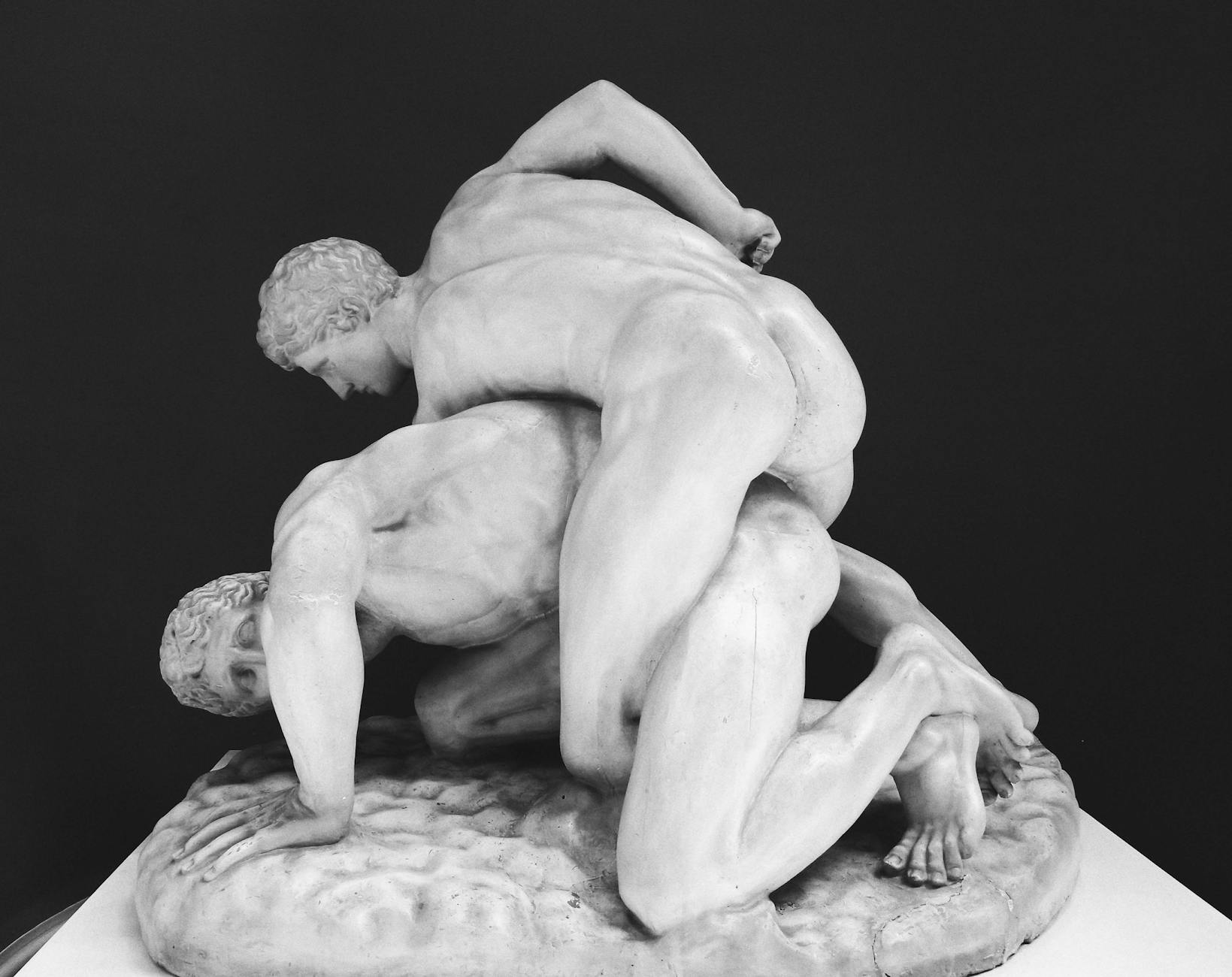
If you've never heard of it, pankration was essentially a no-rules fighting sport that combined wrestling and striking. Athletes could punch, kick, choke, and bend joints. The only things technically prohibited were biting and eye-gouging — rules that were reportedly not always followed. Matches ended when one competitor submitted, lost consciousness, or died. Yes, died. Ancient sources record at least several competitors who were awarded posthumous victories after their opponents surrendered to avoid finishing a fight against a man who had just expired rather than quit.
Pankration champions were among the most celebrated athletes in all of Greece. Theagenes of Thasos reportedly won over 1,300 combat competitions across his career. Polydamas of Skotoussa was said to have killed a lion with his bare hands as a warm-up act for his athletic career. These weren't just sports stories. They were mythology in the making.
Sound Familiar?
Here's where it gets interesting for American sports fans.
On the surface, the ancient Greek approach to athletics and the modern American sports culture couldn't look more different. The US has participation trophies. Youth leagues give everyone equal playing time. The Olympic closing ceremony is practically a group hug. We celebrate the journey, the comeback story, the underdog.
But dig a little deeper, and the parallels are hard to ignore.
American professional sports operate on a winner-takes-all logic that would have felt right at home in ancient Olympia. The Super Bowl doesn't hand out silver medals — the team that loses goes home with nothing but the offseason's worth of "what went wrong" columns. In the NBA, the team that loses the Finals is largely forgotten within a week. The NFL's regular season exists almost entirely to determine who gets into the bracket; the rest is noise.
American sports culture is also deeply intertwined with identity and pride in ways that echo the ancient Greeks. When a city's team wins a championship, the celebration isn't about the players alone — it's a collective statement about the city itself. When the US Olympic team dominates the medal count, it feels like national validation. The ancient Greeks competed as representatives of their city-states, and victory reflected on the entire community. The emotional logic hasn't changed much in 2,800 years.
Even the cult of the individual athletic hero — the LeBrons, the Mahomeses, the Simone Bileses — mirrors the Greek obsession with the champion as a figure touched by something beyond ordinary humanity.
What Got Lost, and What Didn't
The ancient Games collapsed in the late fourth century AD after the Roman Emperor Theodosius I banned pagan festivals. The brutal simplicity of the original competition — one winner, no mercy, divine stakes — gave way to nothing for over a millennium.
When Pierre de Coubertin revived the Olympics in 1896, he deliberately softened the edges. The modern Games were built around international cooperation, amateur idealism, and the idea that participation itself had value. The silver and bronze medals were introduced. The athlete's oath emphasized sportsmanship. The whole framework was constructed as a counter-narrative to ancient ruthlessness.
But the hunger to win never really went away. It just got dressed up in better uniforms.
Every four years, when the world's greatest athletes converge on an Olympic venue, the ancient competitive fire is still burning underneath all the pageantry. The sprinter in lane four doesn't want a participation ribbon. The wrestler doesn't want a consolation bracket. They want to win — completely, definitively, in front of everyone.
In that sense, not much has changed since Koroibos of Elis first crossed the finish line at Olympia and the crowd roared his name into the Greek sky. The olive wreath is gone. The drive it represented never left.