
When Usain Bolt set his 100-meter world record of 9.58 seconds in Berlin in 2009, he wasn't just running against other sprinters—he was racing against the track itself. The Mondotrack surface beneath his feet, the precisely engineered curves, and even the stadium's wind patterns all played invisible roles in that historic performance. This represents the culmination of more than a century of American innovation in athletic venue design.
Sacred Spaces vs. Speed Machines
The ancient Olympic stadium at Olympia tells a very different story. Built around 776 BC, it was designed primarily as a sacred space honoring Zeus, not as a performance-optimizing machine. The track was roughly 200 meters of packed earth, with no standardized lanes or precise measurements. Athletes ran barefoot on dirt, and the "starting line" was simply a stone groove carved into the ground.
Competition was secondary to ceremony. The stadium's orientation aligned with religious significance rather than optimal wind conditions. Spectators sat on grass hillsides, and the only "technology" involved was basic surveying to ensure the track was reasonably straight.
Contrast this with modern American facilities like Hayward Field at the University of Oregon, rebuilt in 2020 with every surface, angle, and environmental factor calibrated for speed. The difference isn't just aesthetic—it's a fundamental shift in philosophy from sport as religious ritual to sport as scientific pursuit.
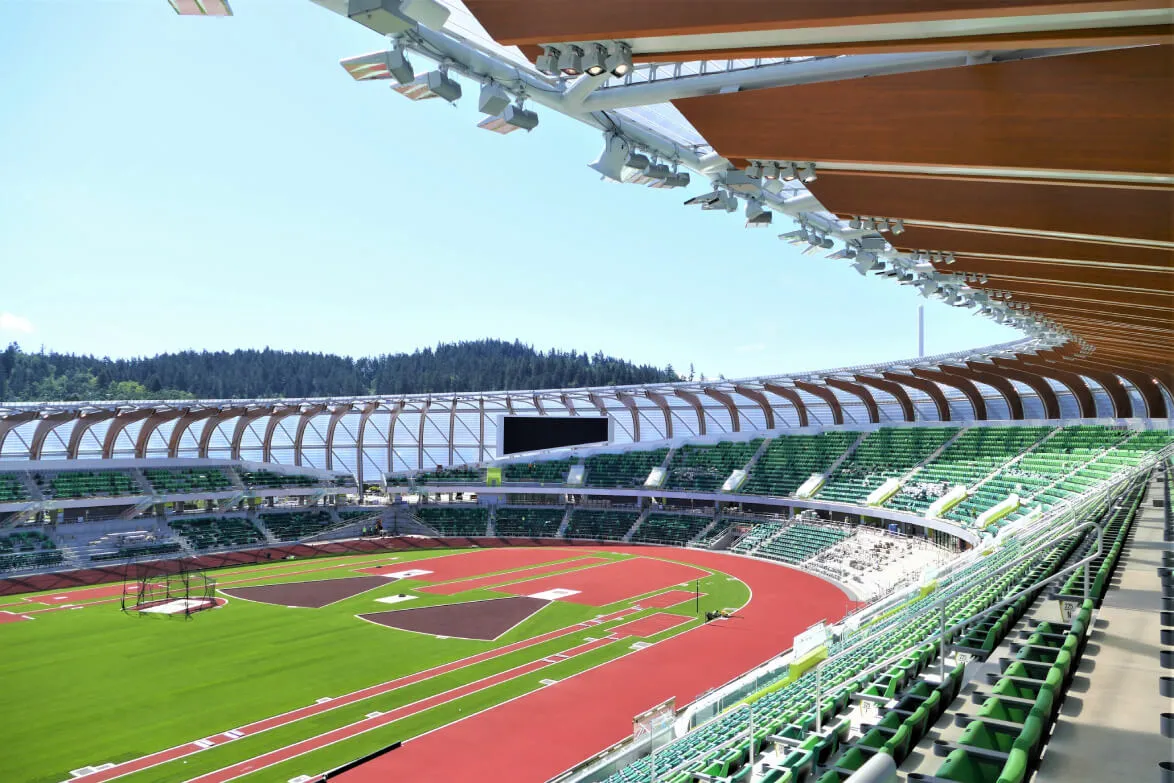 Photo: Hayward Field, via ecpowerslife.com
The American Revolution in Track Surface
America's first contribution to stadium science came through surface innovation. In the early 1900s, most American tracks were still cinder—literally burned coal residue mixed with clay. Runners trained on whatever was available: dirt roads, wooden board tracks, or grass fields.
The breakthrough came in 1963 when 3M engineer Robert Treadwell developed the first synthetic track surface for a high school in Minnesota. Unlike cinder, which varied with weather and wear, synthetic tracks provided consistent energy return with every footstrike.
By the 1968 Olympics in Mexico City, American-made Tartan tracks had become the global standard. The impact was immediate and measurable: Bob Beamon's long jump world record of 29 feet 2½ inches was aided partly by the track's consistent takeoff surface. Ancient Greek athletes jumping into sand pits could never have imagined such precision.
Engineering the Perfect Oval
American engineers didn't stop at surfaces. They began studying the geometry of speed itself. Traditional tracks were simple ovals, but American designers realized that subtle banking in the turns could help athletes maintain velocity through curves.
The Indianapolis Motor Speedway, built in 1909, pioneered banked turns for racing cars. Track and field engineers adapted these principles, creating precisely calculated banking angles that help runners maintain their lean through turns without losing speed.
Modern American tracks feature banking as subtle as 1-2 degrees—imperceptible to spectators but crucial for athletes. The result: corner speeds that would have been impossible on flat ancient tracks.
Climate Control and the Indoor Revolution
Perhaps America's greatest stadium innovation came from solving a uniquely American problem: weather. While ancient Greeks competed only in summer, American athletes needed year-round facilities to match international competition.
The first major indoor track facility opened at Madison Square Garden in 1925, featuring an 11-lap-to-the-mile banked wooden track. But the real revolution came with climate-controlled facilities like the Armory Track in New York, where precise temperature and humidity control create optimal conditions regardless of outside weather.
Today's indoor facilities go further. The Ocean Breeze Athletic Complex in Staten Island features computer-controlled air circulation systems that eliminate wind currents, ensuring that performances aren't aided or hindered by air movement. Ancient Greek athletes, who competed in whatever wind Zeus provided, would find this level of environmental control almost supernatural.
Altitude as a Weapon
American stadium designers also weaponized geography. The 1968 Olympics in Mexico City (altitude 7,350 feet) showed how thin air could dramatically affect performance—sprints became faster due to reduced air resistance, while distance events became slower due to reduced oxygen.
American training facilities now exploit altitude strategically. The Olympic Training Center in Colorado Springs sits at 6,000 feet, while the new USATF facility in Chula Vista, California, is at sea level. Athletes can train at altitude for endurance benefits, then compete at sea level for speed advantages.
This geographic engineering would have been incomprehensible to ancient Greeks, who competed only at Olympia and accepted whatever natural conditions existed there.
The Science of Spectator Energy
Modern American stadiums also engineer crowd dynamics for athletic advantage. Hayward Field's redesign included acoustic modeling to focus crowd noise toward the track, creating a measurable home-field advantage for University of Oregon athletes.
The stadium's seating angles are calculated to create maximum visual intimidation for visiting athletes while providing optimal sightlines for home spectators. Even the warm-up track is positioned to shield home athletes from distracting crowd noise during preparation.
Ancient Olympia had no such considerations. Spectators were secondary to the religious ceremony, and athlete comfort was irrelevant to the gods being honored.
Technology Integration
Today's American stadiums are essentially computers disguised as sports venues. Electronic timing systems accurate to thousandths of seconds, wind gauges that measure conditions in real-time, and photo-finish cameras that can resolve margins invisible to human eyes—all American innovations that have become global standards.
The new Los Angeles Memorial Coliseum, renovated for the 2028 Olympics, features embedded sensors throughout the track surface that will monitor everything from temperature variations to surface wear patterns. This data will help optimize conditions not just during competition, but throughout the facility's lifespan.
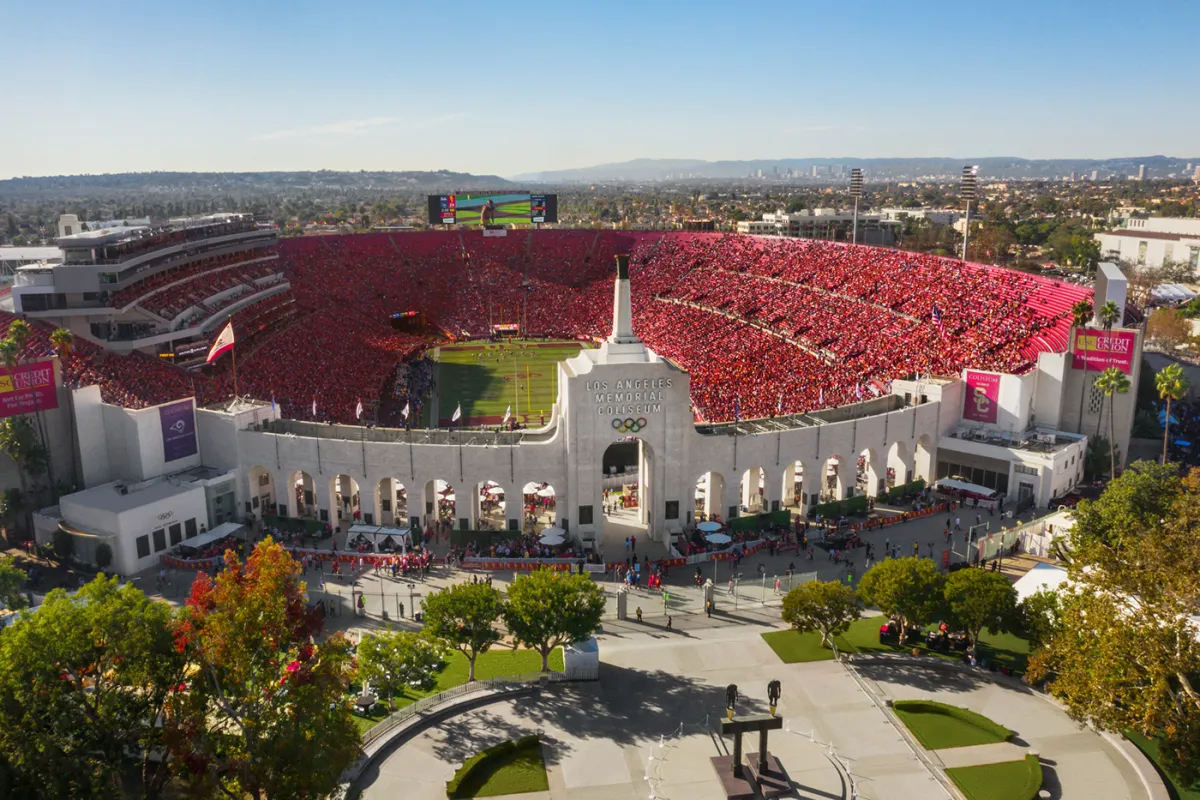 Photo: Los Angeles Memorial Coliseum, via mir-s3-cdn-cf.behance.net
The Future of Fast
American stadium design continues evolving. Nike's headquarters features a track with curves banked at different angles for testing optimal speeds. Some facilities now experiment with adjustable banking that can be modified for different events.
Researchers at MIT are developing "smart surfaces" that could provide real-time feedback about energy return and optimal foot placement. Future stadiums might feature surfaces that adapt to individual athletes' biomechanics.
From Sacred to Scientific
The evolution from ancient Olympia to modern American stadiums represents more than architectural progress—it's a fundamental shift in how we view athletic potential. Ancient Greeks saw sport as a way to honor gods within natural limitations. Americans see sport as a laboratory for transcending those limitations.
This doesn't diminish ancient achievements—those athletes accomplished remarkable feats with minimal technology. But it does highlight how American innovation has quietly revolutionized what's possible when human potential meets engineered perfection.
Every world record set in a modern stadium carries the invisible signature of American engineering. From the synthetic surface to the wind patterns, from the precise geometry to the climate control, the venue itself has become a partner in athletic achievement.
The ancient Greeks gave us the Olympic spirit. Americans gave us the tools to make that spirit fly faster, jump higher, and run longer than ever seemed possible. In the timeline of sports history, the stadium itself became an athlete—one designed, quite literally, to win.