The Race That America Made Famous
While the Olympics gave us the 1500 meters, America gave the world something more romantic: the mile. This slightly longer distance—1,609 meters compared to the metric 1500—became the signature event of American track and field, the race that captured imaginations and created legends from coast to coast.
The mile's story is uniquely American, born from our imperial measurement system and nurtured by generations of college athletes who made it the centerpiece of dual meets across the country. While other nations focused on metric distances, American runners spent more than a century chasing the perfect four laps, creating a racing culture that would eventually influence the entire world.
From Dirt Ovals to Cinder Tracks
The organized mile race emerged in the mid-1800s on the crude tracks of American colleges and athletic clubs. Early races took place on everything from dirt ovals to makeshift courses marked out in fields. The surface was often uneven, the lanes poorly defined, and timing equipment primitive by today's standards.
Yet these humble beginnings produced remarkable performances. The first recorded sub-five-minute mile came in 1852, when British runner Charles Westhall clocked 4:56 on a grass track. American runners quickly embraced the distance, seeing it as the perfect test of speed, stamina, and tactical intelligence.
By the 1870s, American colleges had made the mile their signature event. Harvard, Yale, and Princeton regularly staged mile duels that drew thousands of spectators. The race captured something essential about American competitive spirit: it was long enough to require strategy and endurance, but fast enough to maintain excitement from start to finish.
The Birth of the Sub-Four Dream
The quest for a sub-four-minute mile became track and field's equivalent of climbing Mount Everest. As runners chipped away at the record—4:30, 4:20, 4:15—the four-minute barrier loomed as seemingly impossible.
American runners dominated the early record progression. In 1915, Norman Taber became the first to break 4:15, running 4:12.6 on a dirt track at Harvard. His record stood for nine years, a testament to both his ability and the primitive training methods of the era.
Compare Taber's preparation to modern miling: he trained perhaps 20-30 miles per week, with little understanding of interval training, lactate threshold, or periodization. His diet was whatever the local dining hall served. His shoes were leather with minimal cushioning. His track was often soft dirt that sapped energy with every stride.
Yet Taber and his contemporaries laid the groundwork for everything that followed. They established the mile as track and field's premier event and created the mystique that would eventually drive Roger Bannister to break four minutes in 1954.
The Science Revolution
The transformation of mile training began in earnest after World War II. American coaches like Brutus Hamilton and Bob Giegengack started incorporating interval training methods learned from European coaches. Runners began training year-round instead of just during track season.
The 1950s brought the golden age of American miling. Wes Santee, the Kansas farm boy, became the first American to seriously threaten the four-minute barrier. His rivalry with British runner Roger Bannister captivated sports fans on both sides of the Atlantic.
Santee's training was revolutionary for its time: 70-80 miles per week, systematic interval sessions, and careful attention to racing tactics. He ran 4:02.4 in 1954, tantalizingly close to the magic number. When Bannister broke the barrier three weeks later, running 3:59.4 at Oxford, it felt like a defeat for American track and field.
But American runners quickly responded. Don Bowden became the first American under four minutes in 1957, and by the 1960s, sub-four-minute miles were becoming routine at major college meets.
The Modern Mile Era
Today's elite milers train like endurance athletes crossed with sprinters. They might run 100+ miles per week during base training, then sharpen with 400-meter repeats run faster than most people can sprint a single lap. Their understanding of pacing, tactics, and physiological adaptation would seem like science fiction to runners from Taber's era.
The training evolution is staggering. Modern milers use altitude training, underwater treadmills, and detailed lactate testing to optimize every aspect of preparation. They study video footage of competitors, plan tactical scenarios for different race situations, and work with teams of coaches, physiologists, and sports psychologists.
The results speak for themselves. The current world record of 3:43.13, set by Morocco's Hicham El Guerrouj in 1999, is nearly 30 seconds faster than Taber's 1915 mark. That's an improvement of roughly one second per year across the century—a testament to the steady march of human performance.
America's Lasting Legacy
While the 1500 meters is the Olympic standard, the mile remains track and field's most celebrated distance. The Wanamaker Mile at the Millrose Games, the Prefontaine Classic mile, and countless college dual meet miles continue to captivate audiences in ways that metric races rarely match.
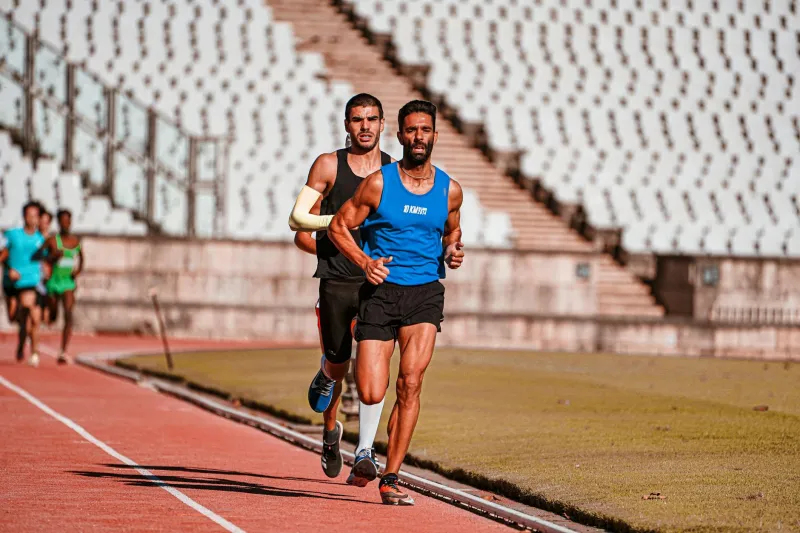
There's something inherently dramatic about four laps. The distance is long enough for tactical complexity—when to move, when to cover moves, when to kick—but short enough that spectators can follow every development. The mile rewards both raw speed and racing intelligence, creating narratives that unfold over eight to ten minutes of pure athletic theater.
American high schools still crown mile champions at state meets across the country. College athletes still dream of running sub-four minutes, joining an exclusive club that numbers fewer than 1,500 people worldwide. The mile continues to serve as track and field's gateway drug, the event that turns casual fans into lifelong devotees.
The Enduring Magic
The mile's appeal transcends pure athleticism. It represents the perfect marriage of human ambition and physical possibility. Anyone can understand the goal—run four laps faster than anyone else—but achieving elite-level success requires years of dedication, intelligent training, and tactical sophistication.
In an era when Olympic events are increasingly specialized and technical, the mile remains beautifully simple. No hurdles to clear, no implements to throw, no judges to impress. Just runners, a track, and the clock. It's pure competition distilled to its essence.
The mile's American origins remind us that the best sporting innovations often emerge organically, from the ground up. While bureaucrats and officials designed many Olympic events, the mile grew naturally from American competitive culture. It became beloved because it deserved to be, earning its status through decades of memorable races and legendary performances.
From dirt tracks to modern synthetic surfaces, from Norman Taber to Ryan Crouser, the mile has remained America's gift to world athletics—a race that captures everything compelling about human performance in four perfect laps.